Cambodia Map
 Buy Printed Map
 Buy Digital Map
 Wall Maps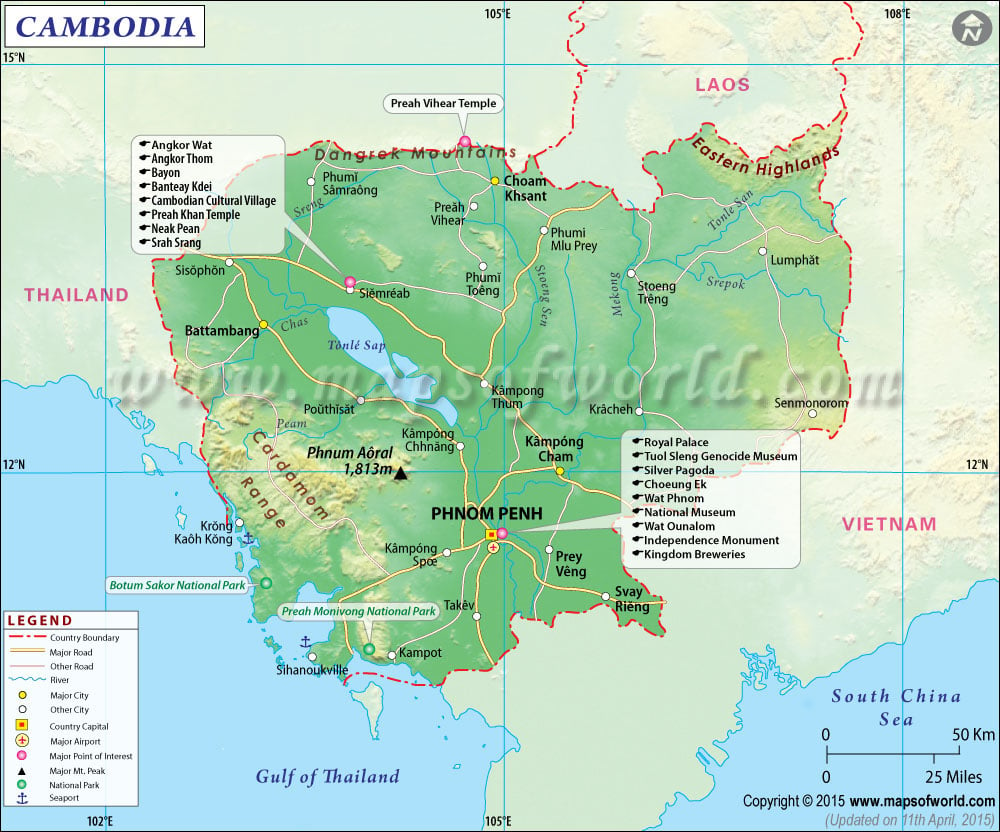
- Neighboring Countries - Vietnam, Thailand, Laos, Malaysia
- Continent And Regions - Asia Map
- Other Cambodia Maps - Where is Cambodia, Cambodia Blank Map, Cambodia Road Map, Cambodia Rail Map, Cambodia River Map, Cambodia Cities Map, Cambodia Political Map, Cambodia Flag
About Cambodia
Explore this Cambodia map to learn everything you want to know about this country. Learn about Cambodia location on the world map, official symbol, flag, geography, climate, postal/area/zip codes, time zones, etc. Check out Cambodia history, significant states, provinces/districts, & cities, most popular travel destinations and attractions, the capital city’s location, facts and trivia, and many more.
| Official Name | (Kingdom of Cambodia) Preah Reach Ana Pak Kampuchea |
| Capital | Phnom-Penh |
| Population | 13.4 million |
| Area | 181,035 sq km or 69,898 sq mi |
| Currency | Riel ($1=3,835) |
| Religion | Theravada Buddhism |
| Literacy | 65% |
| Languages | Khmer, French |
| Major Cities | Phnom-Penh, Battambaug, Kampong, Chan |
| Climate | Tropical monsoon climate |
Cambodia, situated in Southeast Asia, has to its credit the world’s largest cultural monument Angkor Wat, which was built over three centuries-from the 9th century to the 12th century. Though an under-developed country, Cambodia has forests which are rich in valuable timber.
Physical Map of Cambodia
Most of the country consists of a low-lying alluvial plain that occupies the central part of the country. To the southeast of the plain lies the delta of the Mekong River. To the east of the plain, ranges of undulating hills separate Cambodia from Vietnam. To the southwest a mountain range, the Chuor Phnum Kravanh, borders the plain and forms a physical barrier along the country’s coast. Cambodia’s highest peak, Phnom Aural rises in the eastern part of this range. To the north, the Chuor Phnum Dangrek mountains separate Cambodia from Thailand. Cambodia’s most important river is the Mekong, the longest river in Southeast Asia and the tenth largest in the world.
Location of Cambodia
Cambodia is bound by Laos on the northeast, by Vietnam on the east and southeast, by Thailand on the west and northwest and by the Gulf of Thailand on the southwest.
Climate of Cambodia
Cambodia has a tropical monsoon climate. While December and January are the coolest months, March and April are the hottest. Rainfall is experienced from the months of May to October. Average annual rainfall is about 1,400 mm on the central plain and increases to as much as 3,800 mm in the mountains and along the coast. The average annual temperature is about 27°C.
Flag of Cambodia
The flag of Cambodia consists of three horizontal bands – blue at the top, red, double the width, at the center and blue again at the bottom.
The red band, in the center, has a white three-towered temple representing Angkor Wat, which is outlined in black.
Flora And Fauna of Cambodia
Over 50 percent of the land is covered in forests, out of which the dense forest are found in the mountains and along the southwestern coast. Plants growing in Cambodia include rubber, kapok (a tree with seeds that yield a cotton-like fiber), palm, coconut, and banana, all of which are used for commercial purposes. The fauna of Cambodia includes elephants, deer, wild ox, panthers, bears, and tigers. Cormorants, cranes, parrots, pheasants, and wild ducks are also found, and poisonous snakes are numerous. Book Southwest airlines, Mexicana Airlines, Lufthansa Airlines flights online on mapsofworld.com.
People of Cambodia
About 90% of the population is made up of ethnic Cambodians or Khmer and the remaining 5 percent consists of people having Vietnamese origin and 1 percent of Chinese. The remaining 4% is made up of semi-nomadic tribal groups, who are mainly concentrated in the mountainous northeast. The official language is Khmer, or Cambodian.
Around eighty percent of the people live in rural areas, where their principal occupation is farming, basically practiced on family-operated holdings.
Arts, Culture and Music of Cambodia
Cambodia’s art and culture reflect the religious traditions of Hinduism and Buddhism, wherein stone temples, symbolizing the cosmic world, created by Angkor’s architects and sculptors are decorated with wall carvings and sculptures of Hindu gods and the Buddha. Cambodian dances are symbolized by women, dressed in brightly colored costumes with elaborate headdresses. The dances are usually slow, accompanied with graceful movements. The music is created with the help of drums, gongs, and bamboo xylophones. Plays are very famous in the villages of Cambodia, where actors perform with masks. Shadow plays, performed using black leather puppets are also quite famous.
Economy of Cambodia
Despite relatively low yields and a single harvest per year, Cambodia annually exported hundreds of exportable surpluses of its principal crops of rice and corn. But the civil war from 1970 to 1975, the Khmer Rouge regime from 1975 to 1979, and the Cambodia-Vietnam War from 1978 to 1979 shattered Cambodia’s economy. By 1974, rice had to be imported, and production of Cambodia’s most profitable export crop, rubber, fell off sharply. The war also had a negative impact on the country’s fledgling manufacturing industry and severely damaged road and rail networks.
The 1975 regime of Khmer Rouge nationalized all means of production in Cambodia. Money and private property were abolished, and ownership of agriculture was transferred to the people as a group, represented by the state. A Khmer Rouge Four-Year Plan decided upon multiple plantings of rice and a vastly expanded irrigation system. The plan also aimed to increase income from exports of rice and other products and to use this income to buy machinery with a view of industrializing the country. However, the plan fell flat and though rice production rose slightly, thousands of people died from malnutrition and overwork.
After the Khmer Rouge was overthrown in early 1979, and as the government lost grip on the lands, millions of Cambodians attempted to resume their lives as subsistence farmers. By the mid-1990s, Cambodia once again achieved self-sufficiency in rice production and began to export small quantities of rice. The country’s infrastructure improved gradually in the 1990s, mainly through foreign aids and in 2001, its total gross domestic product (GDP) was estimated at $3.4 billion.