Senegal Map
 Buy Printed Map
 Buy Digital Map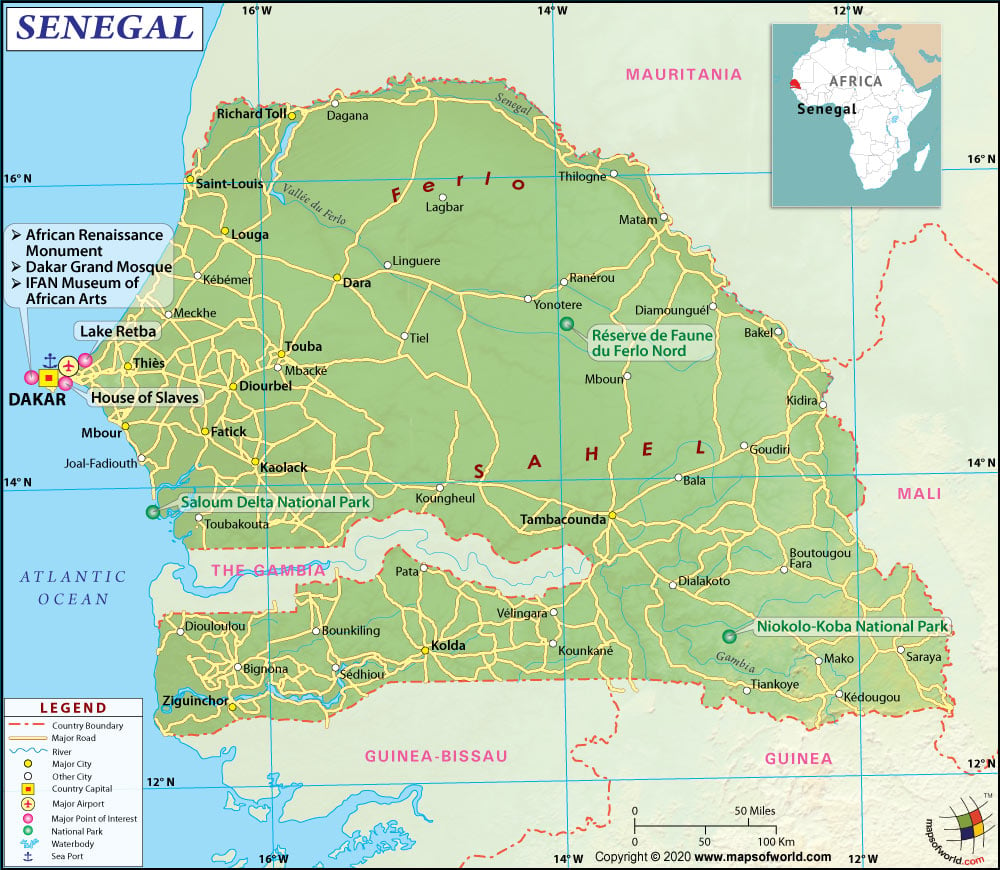
- Neighboring Countries - The Gambia, Mali, Guinea-Bissau, Guinea, Mauritania
- Continent And Regions - Africa Map
- Other Senegal Maps - Where is Senegal, Senegal Blank Map, Senegal Road Map, Senegal Rail Map, Senegal River Map, Senegal Cities Map, Senegal Political Map, Senegal Flag
About Senegal
Explore this Senegal map to learn everything you want to know about this country. Learn about Senegal location on the world map, official symbol, flag, geography, climate, postal/area/zip codes, time zones, etc. Check out Senegal history, significant states, provinces/districts, & cities, most popular travel destinations and attractions, the capital city’s location, facts and trivia, and many more.
| Full name | Republic of Senegal |
| Capital City | Dakar |
| Language | French, Wolof, Serer, Diola, Fula, Tukulor and Mandinka. |
| Currency | Franc CFA. |
| Religion | Islam, Christian, indigenous beliefs. |
| National Anthem | “Pincez Tous vos Koras, Frappez les Balafons”. |
| Newspaper | Il Est Midi, Le Messager, L’Observateur, Le Soleil, Le Qotidien, Sud Quotidien and Wal Fadjri. |
| Places to Visit | Cap Skiring, Dakar, Ziguinchor, Île de Gorèe, Lac Rose, Parc National des Oiseaux du Djoudj and Parc National du Niokolo-Koba. |
| Transport | Airways: convenient routes Africa and Europe to Senegal. The chief service provider is South African Airways; Roadways: Gambia Highway is the most frequently used transit route. You can avail of ‘bush taxis’ from neighboring countries; Railways: Dakar-Bamako train is a choice train option that plies between Senegal and Mali twice a week – once on Wednesday and once on Saturday. |
| Shopping | traditional fabric; embroidery; pottery; jewellery made of clay beads, wood, seeds, copper and other metals; woodcarvings; masks; statues; musical instruments; metal works like pendants, bowls and statuettes; and electronics. |
once lorded over by the Wolof tribe, Senegal was one of the first to host a multi-party democracy in the continent of Africa.
Senegal also served three centuries under French rule, finally achieving independence in 1960.
Physical Map of Senegal
the terrain of Senegal comprises mostly of plain lands which ascends into foothills inland-wards. The plains are either flood plains or sandy plains. There is a semi-desert located in the south and central region of the country. in the south is also the savannah region and the Casamance forest. The chief rivers that navigate the land and finally drain into the Atlantic are Senegal, Gambie, Saloum and Casamance.
Location of Senegal
the nation of Senegal is located in the west coast of the continent of Africa. Bordering its west boundary is the northern region of the Atlantic Ocean. The neighboring political domains are Mauritania in the north and northeast; Mali to the east; and Guinea and Guinea Bissau to the south. The nation of Gambia is a narrow intrusive land mass that juts into the Senegal mainland from the west coast.
Flag of Senegal
The Senegalese flag is rectangular in shape and is made up of a color-scheme that is typically Ethiopian. Even the colors of green, yellow and red that dominate the flag are essentially pro-African colors. The colors appear in three equal vertical stripes with green to the left, yellow in the middle and red in the right. In the central yellow stripe is a green centrally located five-point star.
Climate of Senegal
Senegal is basically a tropical; though it is dependent on the region. The coastal regions are hot, humid and rain-drenched; while the interior regions are dry, blistering and swept by the harmattan winds. The summer months last between May and November and the winter months occur in the months of December to April. The southern region of the country receives more precipitation than the north with rainfall occuring between the months of June and October.
Flora and Fauna of Senegal
Flora: given that Senegal has varied types of habitat, there are a large and diverse variety of plants to be found in the country. They are silk-cotton tree, bamboos, African teak, gingerbread plum, tallow tree, acacias, African locust bean, palm trees, kapok trees, baobabs, coconuts, mango trees and mangroves.
Fauna: Senegal’s fauna life is of two types, on is the desert type and the other is the coastal and savannah variety. The list of animals in Senegal includes elephants, lions, hippopotamuses, buffaloes, leopard, hare, antelopes, chimpanzees, monkeys, wart hogs, jackals, tortoises, lizards and snakes. There are several avian varieties in the country too. Most of them are migratory birds. Some of the names of birds that can be sighted in the country are quail, ducks, painted snipe, spatulas, osprey, sparrows, black rail, crowned ibis, little bee-eater, guinea fowl, bustard, cormorants and bihoreaux. The marine life off the coast of Senegal also offers a lot. Some of the commonly found species are swordfish, oyster, marlin, barracudas and tunas.
People of Senegal
referred to as Senegalese, most of the population of Senegal is made up of Senegalese natives. However, most of them are divided into0 different tribes and clans. Of them the most populous one is the people of the Wolof clan, who have ruled the land for centuries. The other clans that come close are the Pulaar, Jola, Mandinka, Soninke and Sereres. This does not mean that there no foreign population. The population of Senegal has considerable number of people from Lebanon and other European countries.
Arts, Culture and Music of Senegal
- Art: the artistic practices in the country of Senegal are age old traditions. They include weaving fabric; embroidering; pottery making; making jewellery from various metals like steel, iron, bronze, gold, silver and copper, or even wood or beads, seeds and clay; woodcarvings are another popular form of art; carving masks; painting glass; and sculpting statues out materials like wood and stone.
- Culture: the culture of Senegal is a fine blend of French traits with traditional African, and more particularly Wolof, practices. The other factor that influences the culture of Senegal is the religious practices of the people.
- Music: the chief musical genre in Senegal is called the “Sabar” which is always accompanied with dancing. In fact most of the musical traditions in the country are dance based; in the sense that they are composed for dance. The other types of music are the “Nguel” and the “Wango”. The popular musical instruments of the country are the different types of drums like “Neunde”, “Thiol”, “Jembe”, “calabash” and “Riti”. Aside of these there is a xylophone like instrument called the “Balafons”.
Economy of Senegal
Senegal’s economy is primarily based on agriculture. The chief crop of the country is peanuts which are grown in the drought prone regions. Peanut is also an important export commodity. The other agricultural products are millet, corn, cotton and sorghum. Aside of agriculture the other important industry in Senegal is that of fishing. The naturally available resources in the country are phosphates and iron ore. All these together make a substantial export list.