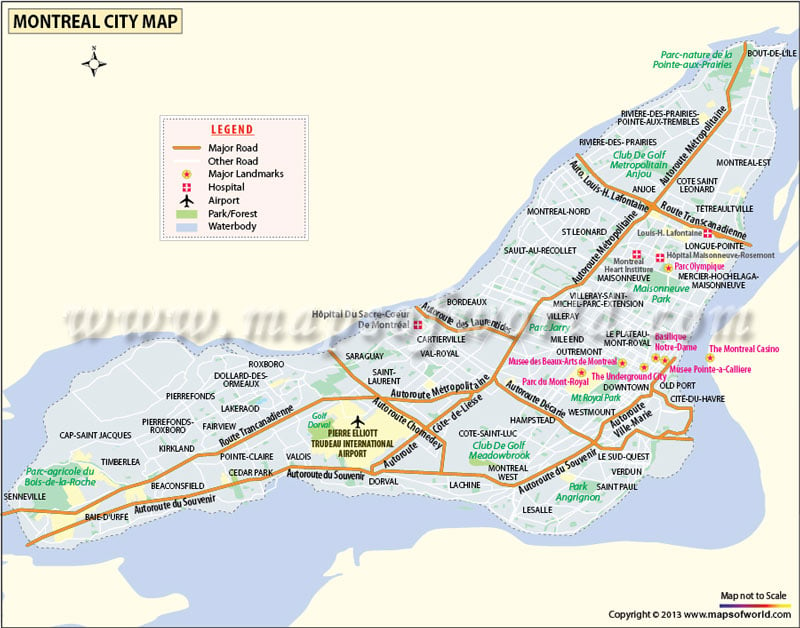
Montreal City Facts |
|---|
| Country | Canada |
|---|---|
| Province | Quebec |
| Region | Montreal |
| Total Area | 141 sq miles |
| Lat Long Coordinates | 45.5081° N, 73.5550° W |
| Time Zone | Eastern Standard Time (UTC-5) |
| Demonyms | Montrealer |
| Area Code | (514, 438), Canada (+1) |
| Languages | English, French |
| Major Religion | Catholic, Christian |
| Museums | Canadian Centre for Architecture, Redpath Museum of Natural History, Canadian Railway Museum, Château Ramezay, McCord Museum of Canadian History, Montreal Biosphère |
| Universities | Université de Montréal, Concordia University, McGill University, Ecole de technologie superieure, HEC Montréal, Université du Québec à Montréal |
| Official Website | http://www.ville.montreal.qc.ca/ |
|
Tourist Places of Attractions
|
Transportation System
|
Montreal is the second largest city in Canada. It is also the largest city in the province of Quebec.
Ranked as the 15th-largest metropolitan area in Northern America and 77th in the world, it was incorporated as a city in the year 1832. It was the capital of the United Province of Canada from 1844 to 1849. It is the Francophone Metropolis of North America. Since most of the streets start with the name ‘Saint’, the city is nicknamed ‘The City Of Saints”. The city is notorious for being the poorest of the four largest cities in Canada. Montreal is also ranked as the number one city in the world to live in for its culture, architecture, history, and ambiance. The head of the city government in Montreal is the mayor, who is first among equals in the City Council.
Area & Location of Montreal: Montreal is situated in the southwestern corner of the province of Quebec, approximately 270 kilometers southwest of Quebec City and 190 kilometers east of Ottawa, the federal capital, 539 kilometers northeast of Toronto, and 610 kilometers north of New York City. Lies on the Island of Montreal at the confluence of the Saint Lawrence and Ottawa Rivers, the city covers a total area of 366.02 sq. km. The Metropolitan area of Montreal has a population of 3,824,221(2011).
Economy: Montreal is an important regional center of commerce, industry, culture, finance, and world affairs.
The important industries in the city include pharmaceuticals, high technology, finance, textile, clothing, higher education, electronic goods, software engineering, building, city engineering, transportation devices, printed goods, fabric, aerospace, and tobacco. Considered the major port city, it is a trans-shipment point for grain, sugar, petroleum products, machinery, and consumer goods. The city is also a center of French Canadian film and television production.
Tourist Attractions: In addition to the skyscrapers, Montreal offers its visitors a variety of attractive places such as amusement parks, museums, stadiums, and so on. La Ronde is the biggest amusement park in Montreal and it is often visited by thousands daily. The Montreal Fireworks Festival held every summer provides a feast for the eyes. Historic areas with attractions such as the Old Port, Place Jacques-Cartier, City Hall, the Marche Bonsecours, Place d’Armes, and Pointe-a-Calliere Museum are also sites visited by tourists. The Olympic stadium of Montreal, which is the world’s tallest inclined tower at 175 meters high and leaning at 45 degrees fascinates the visitors soon after they enter Montreal. The Olympic complex including the Montreal Biodome, Montreal Insectarium, and the Montreal Botanical Garden, one of the largest botanical gardens in the world and Kew in England draws public attention. The four Roman Catholic basilicas Mary, Queen of the World Cathedral, the Notre Dame Basilica, St. Patrick’s Basilica, and Saint Joseph’s Oratory attract pilgrims from far and wide.