Kiribati Map
 Buy Printed Map
 Buy Digital Map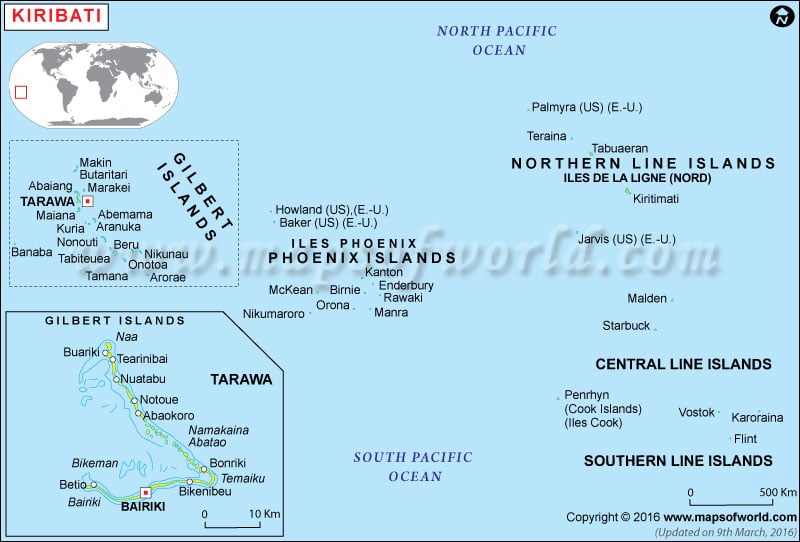
- Continent And Regions - Oceania Map
- Other Kiribati Maps - Where is Kiribati, Kiribati Blank Map, Kiribati Flag
About Kiribati
Explore this Kiribati map to learn everything you want to know about this country. Learn about Kiribati location on the world map, official symbol, flag, geography, climate, postal/area/zip codes, time zones, etc. Check out Kiribati history, significant states, provinces/districts, & cities, most popular travel destinations and attractions, the capital city’s location, facts and trivia, and many more.
| Full name: | Republic of Kiribati |
| Capital City: | Tarawa |
| Language: | English |
| Religion: | Kiribati Protestant Church, Catholic Church, Bahai’i, Christian denominations, Seventh Day Ads, Mormons |
| National Anthem: | Teirake Kaini Kiribati |
| Newspaper: | EIN News, Event Polynesia, Inside Kiribati |
| Places to Visit: | Kiritimati (Christmas) Island, Tarawa, Abaiang, Abemama, Butaritari |
| Transport: | Travel to Tarawa and Christmas Island by taking international flights. One can choose going to Kiribati via the route of Nauru through Air Nauru. One may travel to Christmas Island with the help of yacht from Honolulu,Suva and Fiji. |
| Shopping: | Shopping: Kiribati shark-tooth sword,cups from pandanus leaves, Sea-shell necklaces, Gilbertese canoes, baskets, table mats. |
Visit to a magnificent destination of Kiribati that are unspoiled and untouched that speaks of a true Pacific culture thereby welcoming you to the mesmerizing blue lagoons and scintillating white sand within a peaceful setting.
Physical Map Of Kiribati
Kiribati is comprised of 32 coral reefs and one chief island named as Banaba that covers a total land area of about scattered over 1,351 square miles along the equator. The islands are divided into major categories, which are as follows:
- The Banaba islands which is placed in the midst of Nauru and the Gilbert Islands.
- The Gilbert Islands, which are placed in the northern front of Fiji, are made of 16 atolls.
- The Phoenix Islands is placed towards the southeast of the Gilberts, constitutes of 8 atolls.
- The Line Islands nestled in the eastern part of the Gilberts are appointed with 8 atolls.
The Banaba Island is even chiefly called as the Ocean Island, is covered with phosphates and is highly elevated in its terrain.
The other islands of Kiribati are made up of sands and reef rocks ascending just above the sea level. Get to see calcareous kind of rocks where rearing of food items is quite complicated. Kiritimati is the world’s largest atoll, which is nestled within the Line Islands.
Kiribati is nestled within the easternmost country in the world, and became a part of the Caroline Island that was soon called as the Millennium Island.
Location Of Kiribati
Kiribati, which is spelt as Kiribas, is known as the “smell of the sea”, was previously called as the ‘Gilbert Islands’, and is placed along the central Pacific Ocean, lying in the midst of Hawaii and Fiji.
Flag Of Kiribati
The Kiribati flag was officially accepted during the month of July 12, 1979. The flag is designed with a golden colored frigatebird flying above the bright rising sun towards the upper side of the flag that is set within a red colored background. The lower side is marked with wavy stripes alternatively colored in blue and white, of three stripes each that denotes the serene ocean within the province along with presence of three islands namely the Gilbert, Phoenix and Line Islands. The rays emitting from the sun accounts for 17 in numbers, which relates to the country’s 16 Gilbert Islands along with the previous Ocean Island named now as Banaba. The symbol of the flying frigate bird soaring above the mounting sun is derived from the coat of arms, and carries the meaning of strength and supremacy from the sea.
Climate Of Kiribati
Kiribati is known for its equatorial maritime weather conditions, where temperature varies from time to time. Kiribati is not subjected to tropical cyclones but is prone to strong winds and down pouring especially during the months of December and March. Rainfall hits the region of Kiribati quite irregularly while droughts affect the area quite oftenly. The average temperature ascends to about 28 degree Celsius, with a rise in the level of humidity though the winds coming from the easterly quarter is enough to soothe your senses. Heavy clothing is needed while traveling to this region.
Flora And Fauna Of Kiribati
Kiribati is filled with coconut palms that are surrounded with shrubs like the pandanus, pawpaw and breadfruit along with other coastal plants within the region. The Line and Phoenix Island have extensive resources of fisheries while birds rests along the Christmas Island which includes species like the petrel, tropicbirds, shearwater, frigate birds, terns, noddies and the warbler. Among the aquatic life don’t miss out viewing the Spinner Dolphins, Dragon Moray, Manta, Eagle Rays, Flame Angelfish, turtles and the beautiful corals.
People Of Kiribati
Kiribati witnessed its primitive settlers coming from the Southeast Asian and the Samoa provinces. The local people of the region are called as I-Kirbati where the native of Banaba converses in Gilbertese dialect thereby sharing a commonality with the I-Kiribati community. Tuvaluans community even resides within the region of Kiribati along the Tarawa Island. Kirbati being a British colony accepted English as their official language within the province.
The missionaries of American Protestant came up with the religion of Christianity thereby settling the belief within the area. Whereby about 52 percent of the residents belong to the Catholic community while the rest 40 per cent to the Congregational Protestant. Catholicism was even widespread in the northern region. The major beliefs on which the natives kept their faith on were te maka “the power” or “the magic” along with worshiping the Creator named as Nareau thereby believing in the spirits of ghosts.
Arts, Culture And Music Of Kiribati
Art: The local natives of Kiribati indulge most of their time in crafting handicrafts like making baskets, designing hand made table mats, making cups out of pandanus leaves, using sea shells for ornamenting wonderful pieces of necklaces along with using shark teeth swords from the coconut shell pieces.
Culture: Tabiteuea or the traditional martial arts came into existence within this region. Natives resort to activities like canoe racing, volleyball and soccer along with indulging in native performances and functions.
Music: Kiribati folk music has gained wide popularity in the region, which is based on chanting and vocalizing, conveyed mainly through body thumping. The standing dance popularly called as Te Kaimatoa, or the hip dance known as the Te Buki accompanied with drumming instruments can be widely seen within the region. The native songs of the region are based on love themes that are played during an occasion based on religious ceremony, patriotism, war and wedding purposes. Stick dances known as ‘tirere’ are also carried out during an auspicious occasion. Kiribati Mwaie dancing, a popular dance form is constituted with elements like chorus, dance, ballet and lyric drama that are performed by natives wherein the dance reflects the life the people live within.
Economy of Kiribati
As per the Gross National Product, Kiribati stands as one of the poorest state in the world. In was during the year 1979, Phosphates was exported from the area of Banaba Island, which got exhausted very soon, that created a major impact on the economic development within the country.
Presently Kiribati rests on the foreign aids and returns earned from the country’s fishing permit that finances the imported needs within the state. Kiribati earns a major portion of its earnings from abroad. The country gains from the fishing authorization, development aid, employee’s remittance, and from the tourism industry. Several food crops are grown within the region like bananas, breadfruit, and papaya. Coconut product copra, balances the country’s financial needs to about two-thirds of the portion, which is a major source of export within the region. Goods that are exported to other countries especially to Australia are pet fish, shark fins, and seaweeds. The products that are cultivated here are copra, taro, breadfruit, sweet potatoes, vegetables and fish.