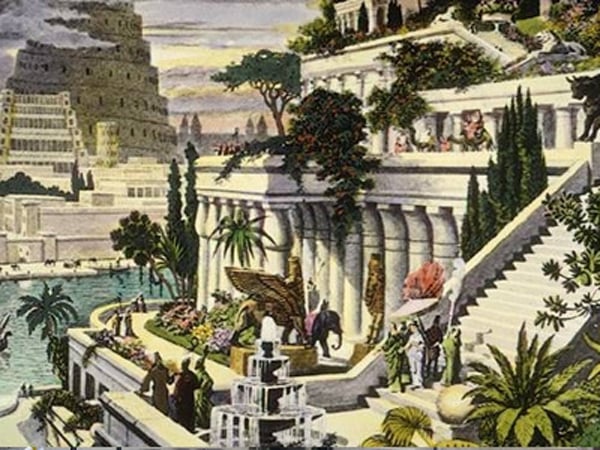
Nebuchadnezzar II, ruler of Babylon is credited with building the Hanging Garden of Babylon to cheer up his homesick wife, Amyitis, who came from a land with more greenery than Babylon had to offer.
Nebuchadnezzar II, ruler of Babylon is credited with building the Hanging Garden of Babylon to cheer up his homesick wife, Amyitis, who came from a land with more greenery than Babylon had to offer. The Greek, Philo of Byzantium described these wonders of Mesopotamia as gardens made on the terraces and parapets of buildings. He along with Strabo described the Hanging Garden of Babylon as containing exotic plants and fountains. The garden contained plants imported from other lands, as Babylon is a dry and arid region. The plants were said to drape themselves over the arches and sides of the building, thus creating a lush and green effect in an otherwise dry region.
Nebuchadnezzar II had ordered nothing short of an engineering marvel when one considers that the water was drawn from the river, Euphrates, and taken all the way up to the terraces of the palaces and other buildings.
The Hanging Garden of Babylon was formed by filling hollow cubical stone pillars with soil and by growing plants in them. The water was raised to the level of the terraces by the use of chain pumps. Babylon doesn’t receive much of rain so it was a constant effort put in by the people employed to keep the garden irrigated. However, one of the challenges faced by having the terrace gardens was the destruction of the foundations of the buildings when the water would be released. To overcome this problem, Diodrus, a Greek historian, writes that the pillars and stone slabs were covered with lead. There were fountains in the terrace that apart from helping to irrigate the plants would also have helped to keep the place cool. The Hanging Garden of Babylon was built with step terraces to closely resemble a green mountainside. The step terraces must have created quite an effect for most ancient Greek historians to write that the city was built to dazzle.
Recent research has however doubted the claims of these Greek Historians and is looking for more information to come through before validating their claims. Despite this the Hanging Garden of Babylon remains one of the most intriguing ideas of the ancient world’s engineering and technological expertise.
