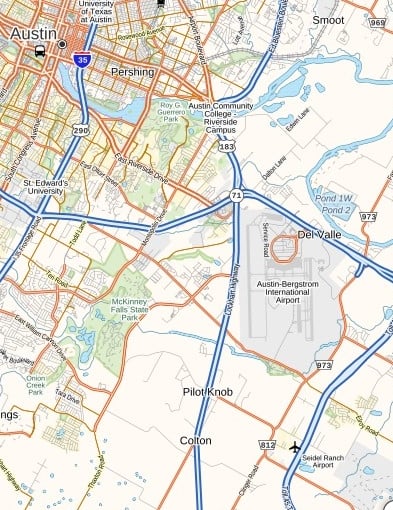
Austin, the capital of Texas, is located on the Colorado river in the Blackland Prairie region. Situated at a height of 501 feet,
Austin in Texas has an area of 251.5 sq. miles. The geographical location of
Austin capital city of Texas is 30.3° N and 97.75° W.
An estimated population of about 710,000 is comprised of 51% males and 49% females. The population density of the city is 2748 per sq. mile. White non-Hispanics constitute 52.9% of the populace of Austin, followed by 30.5% of Hispanics, 10% Blacks, 1.2% Chinese, 1.2% Asian Indians, 1.1% American Indians, 3% of others.
Austin Airports
The airports that serve Austin are Austin-Bergstrom International Airport (AUS), Killeen Muni (ILE), Robert Gray AAF (GRK), Bird's Nest (6R4), Lago-Vista TX – Rusty Allen (5R3), Lakeway Airpark (3R9)
Austin Climate
Austin has a slightly modified maritime type of climate with warm summers and cold winters. The average daily temperature ranges from 50° F in January to 85° F in July. In January the lowest temperature hovers around 40° F. The highest temperature during the month of July can go up to 95° F.
The city experiences the maximum rainfall in the months of May-June. During these months the city receives about 5” of rains. Austin also receives snow from end-December to February. About 0.5” of snow in January is common in Austin.
Tourist Attractions
The tourist attractions in Austin are:
- Austin Museum of Art at 823 Congress Avenue Suite 100;
- Austin Children's Museum at 201 Colorado Street;
- Austin Zoo at 10807 Rawhide Trail
- Bob Bullock Texas State History Museum
- Capitol Complex Visitors Center at 112 East 11th Street
Medical Centers in Austin
Austin has a number of hospitals and medical centers. Some of them are:
- Austin State Hospital in 4110 Guadalupe
- Healthsouth Surgery Hospital of Austin in 6818 Austin Central Boulevard, Suite 100
- St. Davids Hospital in 919 East, 32nd Street