 Buy Printed Map
 Buy Digital Map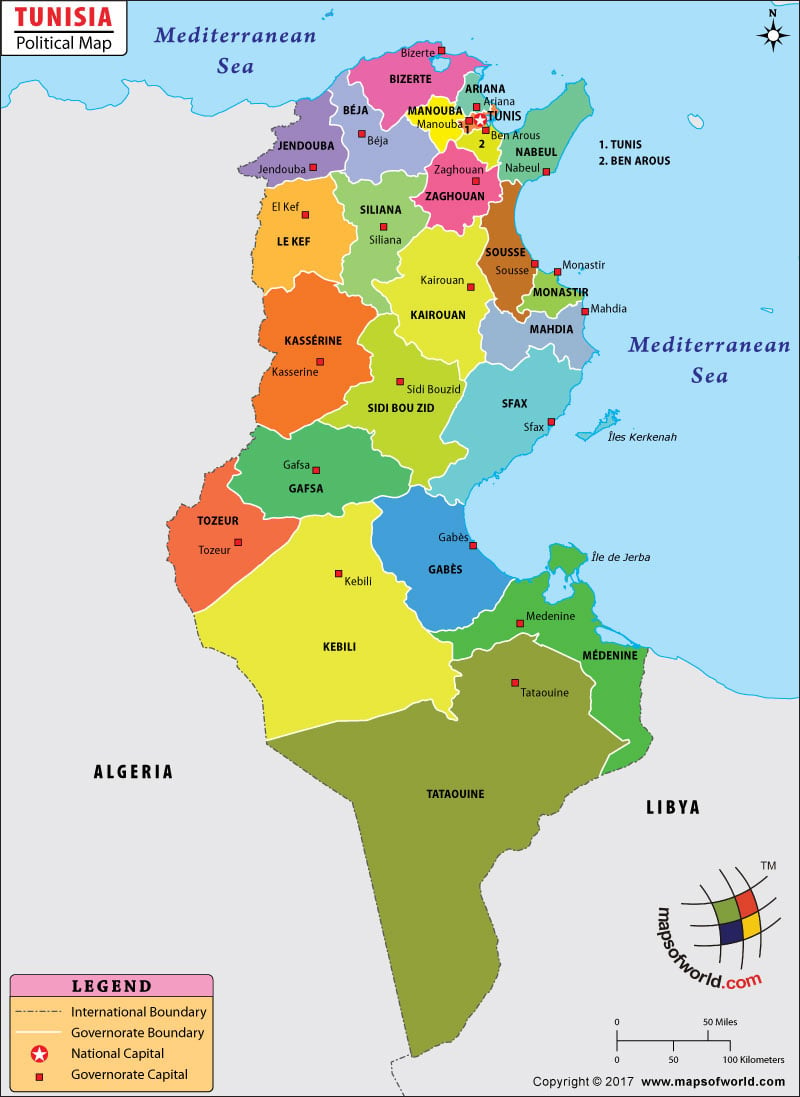
- Tunisia Cities - Tunis
- Neighboring Countries - Algeria, Libya, Italy
- Continent And Regions - Africa Map
- Other Tunisia Maps - Tunisia Map, Where is Tunisia, Tunisia Blank Map, Tunisia Road Map, Tunisia Rail Map, Tunisia River Map, Tunisia Flag Map
The African country Tunisia covers a total area of 163,610 square kilometers. About 17.5% of the land of the country is arable. The residents of the country are known as Tunisians. Majority of the people of Tunisia are Muslims. In the Tunisia political map, the major cities, national capital, international and internal boundaries have been marked by using specific symbols. The scale of the map has also been provided.
Tunisia Features
Tunisia is a North African country, which is located at the Mediterranean coast. The geographic coordinates of Tunisia are 34° North latitude and 9° East longitude. The country’s coastline stretches for a distance of 1148 kilometers. The country has mountains in the north, semiarid regions in the south and dry terrain in the central part. The population of the country as per the estimate of July 2007 is 10,276,158.
Tunisia Boundaries
The bordering nations and water bodies of Tunisia have been clearly indicated in the political map of Tunisia. The indicated water bodies in the map of Tunisia are:
- Mediterranean Sea
- Gulf of Gabes
- Golfede Hammamet
- Gulf of Tunis
- Strait of Sicily
The bordering nations of Tunisia are:
- Algeria in the western side
- Libya in the southeastern side
Tunisia Governorates
For administrative purpose Tunisia has been divided into 24 governorates that are pointed out in the printable map of Tunisia by different colors. The internal boundaries of the governorates are clearly pointed out in the map. The governorates of Tunisia are:
Beja (Bajah), Ariana (Aryanah), Bizerte (Banzart), Ben Arous (Bin ‘Arus), Gafsa (Qafsah), Gabes (Qabis), Kairouan (Al Qayrawan), Jendouba (Jundubah), Kebili (Qibili), Kasserine (Al Qasrayn), Mahdia (Al Mahdiyah), Kef (Al Kaf), Medenine (Madanin), Manouba (Manubah), Monastir, Nabeul (Nabul), (Al Munastir), Sidi Bou Zid (Sidi Bu Zayd), Sfax (Safaqis), Sousse (Susah), Siliana (Silyanah), Tozeur (Tawzar), Tataouine (Tatawin), Zaghouan (Zaghwan) and Tunis.
The capitals of Tunisia governorates have been indicated in political Tunisia map by white squares. Some of the indicated governorates capitals are Medenine, Tataouline, Gabes, Kebili, Le Kef, Gafsa, Nabeul, Siliana and Jendouba.
Tunisia Cities
The major cities of the country are highlighted in the map of Tunisia by black dots. Some of the major cities of Tunisia are Remade,El Borma, El Hamma, Matmata, Thala, Nefta, Tabarka, El Djem, Menzel Bourguiba.
Tunisia Capital
Tunis is the capital of Tunisia. The capital city is served by Tunis/ Carthage airport. The geographic coordinates of Tunis are 36°48′ 10″ North latitude and 10° 10′ 47″ East longitude. The city is 3 feet above sea level. Some of the cities located in close proximity to Tunis are Bab Khadra, Kasbah, Al Madinah, Bab as Suwayqah, Montfleury and Bab al Jazirah.
There are many tourist attractions at Tunis. The medina of Tunis was declared as a UNESCO World Heritage Site in the year 1979. The income of the national capital is boosted by products like olive oil, carpets and textiles.
| Governorate | Population | Area(km.²) | Area(mi.²) | Arabic |
|---|---|---|---|---|
| Ariana | 422,246 | 1,558 | 602 | Al Aryanah |
| Beja | 304,501 | 3,558 | 1,374 | Bajah |
| Ben Arous | 505,773 | 761 | 294 | Bin `Arus |
| Bizerte | 524,128 | 3,685 | 1,423 | Banzart |
| Gabes | 342,630 | 7,175 | 2,770 | Qābis |
| Gafsa | 323,709 | 8,990 | 3,471 | Qafsah |
| Jendouba | 416,608 | 3,102 | 1,198 | Jundubah |
| Kairouan | 546,209 | 6,712 | 2,592 | Al Qayrawan |
| Kasserine | 412,278 | 8,066 | 3,114 | Al Qasrayn |
| Kebili | 143,218 | 22,084 | 8,527 | Qibili |
| Le Kef | 258,790 | 4,965 | 1,917 | Al Kaf |
| Mahdia | 377,853 | 2,966 | 1,145 | Al Mahdiyah |
| Manouba | 335,912 | Manubah | ||
| Medenine | 432,503 | 8,588 | 3,316 | Madaniyin |
| Monastir | 455,590 | 1,019 | 393 | Al Munastīr |
| Nabeul | 693,890 | 2,788 | 1,076 | Nabul |
| Sfax | 855,256 | 7,545 | 2,913 | Safaqis |
| Sidi Bou Zid | 395,506 | 6,994 | 2,700 | Sidi Bu Zayd |
| Siliana | 233,985 | 4,631 | 1,788 | Silyanah |
| Sousse | 544,413 | 2,621 | 1,012 | Susah |
| Tataouine | 143,524 | 38,889 | 15,015 | Taţawin |
| Tozeur | 97,526 | 4,719 | 1,822 | Tawzar |
| Tunis | 983,861 | 346 | 134 | Tunis |
| Zaghouan | 160,963 | 2,768 | 1,069 | Zaghwan |
| 24 governorates | 9,910,872 | 154,530 | 59,665 |
 Tunisia Facts