 Buy Printed Map
 Buy Digital Map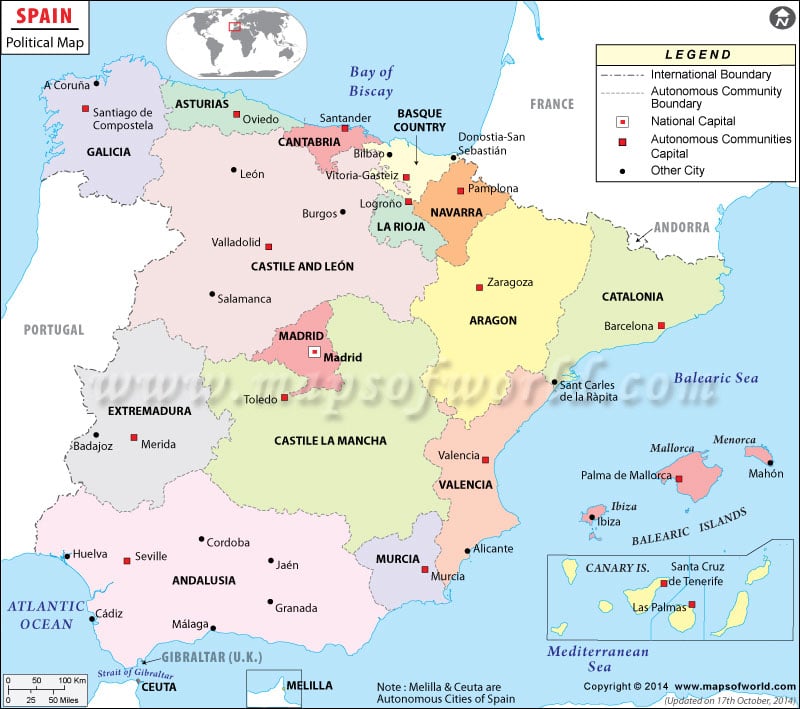
- Spain Cities -Barcelona, Bilbao, Madrid, Murcia, Rota, Seville, Valencia
- Neighboring Countries - Portugal, Morocco, Andorra, France
- Continent And Regions - Europe Map
- Other Spain Maps - Spain Map, Where is Spain, Spain Blank Map, Spain Road Map, Spain Rail Map, Spain River Map, Spain Physical Map, Spain Flag
Spain, one of the oldest countries in Europe, was a powerful nation in the sixteen and seventeenth centuries. The third largest country in Europe, Spain, is heavily influenced by Moorish and European society. Culturally a rich land, Spain has also been blessed with mesmerizing landscapes, making it the second biggest tourism destination in the world.
One of the wealthiest nations of the ancient world, Spain has had to struggle in the recent past to gain economic stability.
At present Spain is the 13th most economically developed country in the world.
Spain borders with:
A Political Timeline of Spain
| 2nd Century BC | Celts, Iberians, and Basques (people of Spain) became part of the Roman Empire |
| 711 AD | Muslim army invaded Iberia |
| 913AD | Capital is set up in Leon by the Christians after northern Spain is retaken |
| 1492 | Granada, the last Muslim stronghold, was captured |
| 1701 – 1714 | ‘Succession of Spanish war’; Spanish throne was accepted by the Bourbon dynasty |
| 1913 | Spain declared a republic |
| 1975 | Spain became a constitutional monarchy |
| 1977 | First democratic election |
| 1978 | Constitution institutes Parliamentary Monarchy |
| 1995 | Spain joins the European community |
Economy
Spain has a capitalist mixed economy, which is the thirteen largest in the world. Spain is also the third-largest world investor. Spain’s GDP for the year 2011 is estimated to be $1.411 trillion. Like many other nations Spain’s economy was impacted by a recession in late 2007, but fortunately, by 2011 the country again experienced positive growth. Spain’s tourism industry also contributes substantially to the country’s GDP. In fact, Spain’s tourism industry is the second biggest in the world.
Spain is also one of the world’s leading countries in the development and production of renewable energy. In 2010 Spain set up a solar power station plant called La- Florida in Badajoz and became the world leader.
Political History and Divisions:
Spain’s strategic location along the ocean and seas has helped her to have control over many colonies in the past. At present also Spain controls a number of territories in northern Morocco.
Spain has a Parliamentary Monarchy, where the Prime Minister is answerable to the Congress of Deputies and Senate. The Prime Minister is elected every 4 years. The monarch serves as the head of the state and commander in chief of the forces. The seventeen regions of Spain have their own sovereign governments. The central government only delegates powers to the regional governments, especially for health care, education, and other social programs. At present, Spain’s Prime Minister is Pedro Sánchez.
Quick Facts
| Official Name | Kingdom of Spain |
| Capital city | Madrid |
| Administrative units | Seventeen regions, two autonomous cities |
| Total Members of Congress of Deputies | 350 |
| Total Members of Senate | 259 |
| Head of the Government | Prime Minister Pedro Sánchez Pérez-Castejón since 2018. |
| Head of the State | King King Felipe VI |
| Type of Government | Parliamentary Monarchy |
| Dominant Political Parties | People’s Party (PP), Spanish Socialist Workers Party (PSOE) |
Spain’s Regions and their Capitals:
| Region | Capital | Region | Capital | Region | Capital |
|---|---|---|---|---|---|
| Andalusia | Seville | Castile-La Mancha | Toledo, Albacete | Region of Murcia | Murcia |
| Aragon | Saragossa | Castile and Leon | Valladolid, Burgos, Leon | Chartered Community of Navarre | Pamplona |
| Principality of Asturias | Oviedo | Catalonia | Barcelona | Valencian Community | Valencia |
| Balearic Islands | Palma | Extremadura | Merida | ||
| Basque Country | Vitoria-Gasteiz | Galicia | Santiago de Compostela, Corunna | ||
| Canary Island | Santa Cruz de Tenerife & Las Palmas | La Rioja | Logrono | ||
| Cantabria | Santander | Community of Madrid | Madrid |
| Community | Population | Area(km.²) | Area(mi.²) | Capital |
|---|---|---|---|---|
| Andalusia | 7,357,558 | 87,268 | 33,694 | Seville |
| Aragon | 1,204,215 | 47,669 | 18,405 | Zaragoza |
| Asturias | 1,062,998 | 10,565 | 4,079 | Oviedo |
| Balearic Islands | 841,669 | 5,014 | 1,936 | Palma de Mallorca |
| Basque Country | 2,082,587 | 7,261 | 2,803 | Vitoria-Gasteiz |
| Canary Islands | 1,694,477 | 7,273 | 2,808 | Santa Cruz de Tenerife |
| Cantabria | 535,131 | 5,289 | 2,042 | Santander |
| Castile and Leon | 2,456,474 | 94,147 | 36,350 | Valladolid |
| Castile-La Mancha | 1,760,516 | 79,226 | 30,589 | Toledo |
| Catalonia | 6,343,110 | 31,930 | 12,328 | Barcelona |
| Ceuta | 71,505 | 18 | 7 | Ceuta |
| Extremadura | 1,058,503 | 41,602 | 16,063 | Merida |
| Galicia | 2,695,880 | 29,434 | 11,365 | Santiago de Compostela |
| La Rioja | 276,702 | 5,034 | 1,944 | Logrono |
| Madrid | 5,423,384 | 7,995 | 3,087 | Madrid |
| Melilla | 66,411 | 14 | 5 | Melilla |
| Murcia | 1,197,646 | 11,317 | 4,370 | Murcia |
| Navarra | 555,829 | 10,421 | 4,024 | Pamplona |
| Valencia | 4,162,776 | 23,305 | 8,998 | Valencia |
| 19 divisions | 40,847,371 | 504,782 | 194,897 |
| Province | Population | Area(km.²) | Capital | Gentilic |
|---|---|---|---|---|
| A Coruna | 1,096,027 | 7,876 | A Coruna | corunes |
| Alava | 286,387 | 3,047 | Vitoria-Gasteiz(1) | alaves |
| Albacete | 364,835 | 14,858 | Albacete | albaceteno |
| Alicante | 1,461,925 | 5,863 | Alicante | alicantino |
| Almeria | 536,731 | 8,774 | Almeria | almeriense |
| Asturias | 1,062,998 | 10,565 | Oviedo | asturiano |
| avila | 163,442 | 8,048 | avila | abulense |
| Badajoz | 654,882 | 21,657 | Badajoz | pacense |
| Baleares | 841,669 | 5,014 | Palma | balear |
| Barcelona | 4,805,927 | 7,733 | Barcelona | barcelones |
| Burgos | 348,934 | 14,269 | Burgos | burgales |
| Caceres | 403,621 | 19,945 | Caceres | cacereno |
| Cadiz | 1,116,491 | 7,385 | Cadiz | gaditano |
| Cantabria | 535,131 | 5,289 | Santander | cantabro |
| Castellon | 484,566 | 6,679 | Castellon de la Plana | castellonense |
| Ceuta | 71,505 | 18 | Ceuta | ceuti |
| Ciudad Real | 478,957 | 19,749 | Ciudad Real | ciudadrealeno |
| Cordoba | 761,657 | 13,718 | Cordoba | cordobes |
| Cuenca | 200,346 | 17,061 | Cuenca | conquense |
| Girona | 565,304 | 5,886 | Girona | gerundense |
| Granada | 821,660 | 12,531 | Granada | granadino |
| Guadalajara | 174,999 | 12,190 | Guadalajara | guadalajareno |
| Guipuzcoa | 673,563 | 1,997 | Donostia-San Sebastian(1) | guipuzcoano |
| Huelva | 462,579 | 10,085 | Huelva | onubense |
| Huesca | 206,502 | 15,671 | Huesca | oscense |
| Jaen | 643,820 | 13,498 | Jaen | jienense |
| La Rioja | 276,702 | 5,034 | Logrono | riojano |
| Las Palmas | 887,676 | 4,065 | Las Palmas de Gran Canaria | palmense |
| Leon | 488,751 | 15,468 | Leon | leones |
| Lleida | 362,206 | 12,028 | Lleida | ilerdense |
| Lugo | 357,648 | 9,803 | Lugo | lucense |
| Madrid | 5,423,384 | 7,995 | Madrid | madrileno |
| Malaga | 1,287,017 | 7,276 | Malaga | malagueno |
| Melilla | 66,411 | 14 | Melilla | melillense |
| Murcia | 1,197,646 | 11,317 | Murcia | murciano |
| Navarra | 555,829 | 10,421 | Pamplona | navarro |
| Ourense | 338,446 | 7,278 | Ourense | orensano |
| Palencia | 174,143 | 8,029 | Palencia | palentino |
| Pontevedra | 903,759 | 4,477 | Pontevedra | pontevedres |
| Salamanca | 345,609 | 12,336 | Salamanca | salmantino |
| Santa Cruz de Tenerife | 806,801 | 3,208 | Santa Cruz de Tenerife | tinerfeno |
| Segovia | 147,694 | 6,949 | Segovia | segoviano |
| Sevilla | 1,727,603 | 14,001 | Sevilla | sevillano |
| Soria | 90,717 | 10,287 | Soria | soriano |
| Tarragona | 609,673 | 6,283 | Tarragona | tarraconense |
| Teruel | 135,858 | 14,804 | Teruel | turolense |
| Toledo | 541,379 | 15,368 | Toledo | toledano |
| Valencia | 2,216,285 | 10,763 | Valencia | valenciano |
| Valladolid | 498,094 | 8,202 | Valladolid | vallisoletano |
| Vizcaya | 1,122,637 | 2,217 | Bilbao | vizcaino |
| Zamora | 199,090 | 10,559 | Zamora | zamorano |
| Zaragoza | 861,855 | 17,194 | Saragossa | zaragozano |
| 52 divisions | 40,847,371 | 504,782 |
