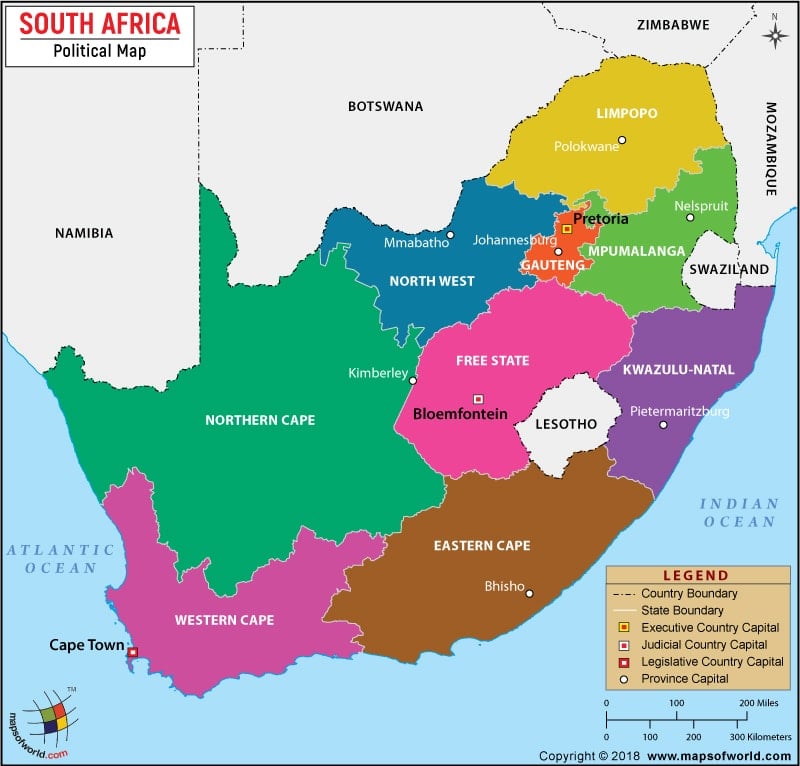
South Africa is one of the most popular tourist destinations of Africa and is also the founding member of African Union and United Nations. and the country has the largest economy in the continent. Once indicted of the infamous Apartheid policy, the country by is now an established democratic multi- racial country, with people of all communities and races living in harmony. South Africa is now considered one of the emerging superpowers; and is part of the BRICS alliance.
Location of South Africa:
Located at the southern-most region of Africa, South Africa occupies an area of 3,71,433 sq miles, in the southern hemisphere. South Africa is bounded by South Atlantic Ocean in the West and South coast and by the Indian Ocean in the eastern coast. The geographical coordinates of South Africa are 29.81"S and 25.34" E. Climatically, South Africa has mild temperate climate.
Economy and Agriculture
South Africa the largest economy of Africa contributes to about 24% of the continent's GDP (PPP). Post the 1994 democratic multiracial elections, the country's economic policies have been reformed, with a focus on macroeconomic policies, creating job opportunities and opening the markets to foreign investors. South Africa also has a strong financial system along with a robust strong energy and communication sector and has loads of natural resources, which make the country a part of the BRICS. South Africa's GDP as per 2011 is is pegged at US $422 billion. During the recession period South Africa suffered economically, however with the help of private and public consumption growth, the economy has recovered again.
Agriculturally, South Africa is one of the world's largest producers of cereals, nuts, chicory roots, castor oil seeds, grapefruit etc. Agriculture contributes to about 10% of the country's GDP. Some of the major mineral resources, which support South Africa's economy are are gold, diamond, platinum, chromium, etc.
Political History and Divisions
South Africa is divided into nine provinces and has three capitals. South African government, which is parliamentary, constitutional democratic, federal, and presidential in nature, has three branches: the Legislature, the Executive, and the Judiciary. The parliament of South Africa has two houses: the National Assembly, which is the lower house and has 400 members, and the National Council of Provinces, which is the upper house and has of 90 members (10 members from each province). The President is the head of the state and the government. The responsibilities of the government are clearly defined in the constitution. South Africa, though an independent republic since 1948, actually got freedom from apartheid in 1994. South Africa is 'One party state', and post 1994 the policies of the African National Congress have determined the course of South Africa's politics.
Major Cities of South Africa
Pretoria: It is the administrative capital, situated at a height of about 1330 m above sea level. The geographic coordinates of the city are 25"44'S and 28"11'E. Most of the streets of Pretoria are avenues lined with Jacaranda Trees; hence, the city locally is called as Jacaranda city.
Cape Town: Cape Town is the legislative capital and is the second most populated city of South Africa. It is South Africa's second main economic center, also is a prominent tourist destination because of its equitable climate, beautiful beaches, natural setting, and well-developed infrastructure. Its latitudinal coordinate is 33" 55' S and longitude is 18" 22' E.
Bloemfontein: It is the judicial capital, popularly known as 'City of Roses'. Its latitudinal extent is 27" 38' S and longitude is 25" 32' E. It is also the capital city of Free State province.
Johannesburg: It is the largest city of South Africa and the economic hub of the country. This city is well connected with most of the other important cities of South Africa. This city also is the seat of the 'court of constitution', where the ultimate constitutional decision are taken.
| 4th century | San, Khoikhoi and Bantu tribes joined by people migrating from the north |
|---|---|
| 1652 | Dutch East India Company establishes Cape Town |
| 1795 | Cape Town is seized by the British colonists |
| 1803 | Cape Colony is returned to Dutch |
| 1806 | British again gains control over Cape colony |
| 1816 - 1826 | Zulu empire is founded and sees rapid expansion |
| 1835 -1840 | Boers leave Cape Colony to establish the Orange Free State and Transvaal |
| 1867 | Diamond is discovered in South Africa |
| 1879 | British defeat Zulus |
| 1880- 1881 | First Anglo - Boer War between British and Boers |
| 1886 | Gold is discovered |
| 1899 | Second Anglo- Boer War begins |
| 1902 | Second Anglo British war ends and Treaty of Vereeniging is signed |
| 1910 | Union of South Africa is formed by former colonies Cape, Natal, Transvaal and Orange Free State |
| 1912 | African National Congress formed (Formerly known as Native National Congress) |
| 1914 | National Party formed |
| 1948 | National Party while in power adopts Apartheid Policy |
| 1961 | South Africa becomes Republic |
| 1994 | First multi-racial democratic elections are held. |
| Quick Political Facts | |
|---|---|
| Official Name | Republic of South Africa |
| Capital | Pretoria (administrative Capital), Cape Town (Legislative Capita), Bloemfontein (Judicial Capital) |
| Administrative Units | 9 Provinces and 3 capitals |
| Houses of the Parliament (Legislative) | National Assembly (Lower House) and National Council of Provinces (Upper House). |
| Type of Government | Federal republic; constitutional democracy, Parliamentary and Presidential |
| Head of the State and the Government | President Jacob Zuma |
| Members in National Assembly (Lower House) | 400 Members |
| Members in National Council of Provinces (Upper House) | 90 Members |
| Major Political Party | African National Congress |
The Provinces and Their Capitals
| Province | Capital | Province | Capital |
|---|---|---|---|
| Eastern Cape | Bhiso | Mpumalanga | Nelspruit |
| Free State | Bloemfontein | North West | Mafikeng |
| Gauteng | Johannesburg | Northern Cape | Kimberley |
| KwaZulu- Natal | Pietermaritzburg | Western Cape | Cape Town |
| Limpopo | Polokwane |
| Province | Pop-2001 | Pop-1996 | Area(km.²) | Area(mi.²) | Capital | Former |
|---|---|---|---|---|---|---|
| Eastern Cape | 6,436,761 | 6,302,525 | 169,952 | 65,619 | Bhisho | Cape of Good Hope |
| Free State | 2,706,776 | 2,633,504 | 129,821 | 50,124 | Bloemfontein | Orange Free State |
| Gauteng | 8,837,172 | 7,348,423 | 16,927 | 6,536 | Johannesburg | Transvaal |
| KwaZulu-Natal | 9,426,019 | 8,417,021 | 92,303 | 35,638 | Pietermaritzburg | Natal, Cape of Good Hope |
| Limpopo | 5,273,637 | 4,929,368 | 122,839 | 47,429 | Polokwane | Transvaal |
| Mpumalanga | 3,122,994 | 2,800,711 | 79,512 | 30,700 | Nelspruit | Transvaal |
| Northern Cape | 822,726 | 840,321 | 362,591 | 139,997 | Kimberley | Cape of Good Hope |
| North-West | 3,669,350 | 3,354,825 | 116,180 | 44,857 | Mmabatho | Transvaal, Cape of Good Hope |
| Western Cape | 4,524,335 | 3,956,875 | 129,448 | 49,980 | Cape Town | Cape of Good Hope |
| 9 provinces | 44,819,770 | 40,583,573 | 1,219,574 | 470,880 |
Note : -Pop-2001: 2001-10-10 census.
Area: Source is Municipal Demarcation Board.
Last Updated On : October 25, 2012