Macedonia Map
 Buy Printed Map
 Buy Digital Map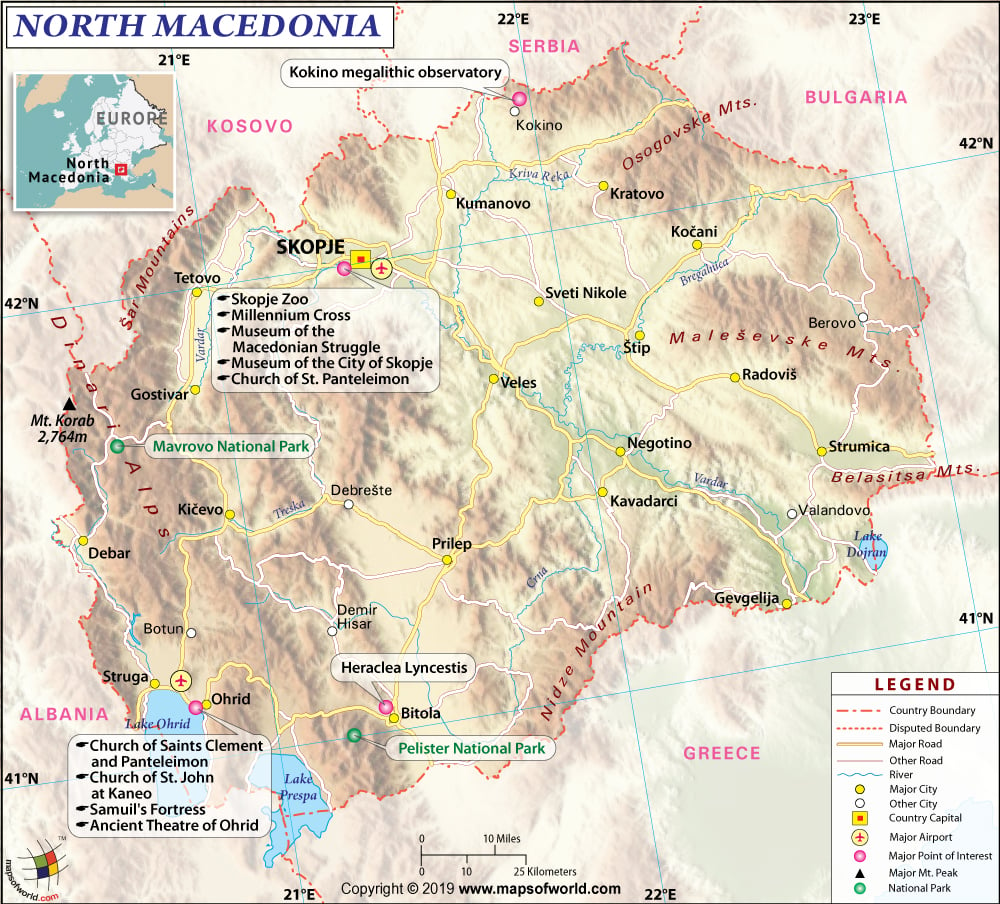
- Neighboring Countries - Kosovo, Bulgaria, Albania, Greece, Serbia
- Continent And Regions - Europe Map
- Other Macedonia Maps - Where is Macedonia, Macedonia Blank Map, Macedonia Road Map, Macedonia Rail Map, Macedonia River Map, Macedonia Cities Map, Macedonia Political Map, Macedonia Flag
About Macedonia
Explore this Macedonia map to learn everything you want to know about this country. Learn about Macedonia location on the world map, official symbol, flag, geography, climate, postal/area/zip codes, time zones, etc. Check out Macedonia history, significant states, provinces/districts, & cities, most popular travel destinations and attractions, the capital city’s location, facts and trivia, and many more.
| Full name: | Republic of Macedonia |
| Capital City: | Skopje |
| Language: | Indo-European Slavic language |
| Currency: | Macedonian Denar |
| Religion: | Orthodox, Muslim |
| National Anthem: | Denes Nad Makedonija that literally means Today Above Macedonia |
| Places to Visit: | Ohrid, Skopje, Lake Matka, Sveti Jovan Bigorski Monastery, Treskavec Monastery and many other exciting places. |
| Transport: | Airways: frequent flights from Skopje to the major cities in Germany, the Netherlands and Switzerland. Roadways: bus arrangements are there between some major places like Sofia, Istanbul, Belgrade, Tirana and also between Tetovo and Tirana. Railways: you will get frequent Express train services for five times in a day. This service is for visiting places between Skopje and Belgrade and also between Skopje and Thessaloniki. |
| Shopping: | In Macedonia you will find unique types of ceramic pots, some handicraft works made by the local people and many more things. |
Macedonia is a very beautiful country, situated in the southern Europe. While visiting the country you can visit the places that bear the historical significance of the nation. Some beautiful churches, monasteries and mosques are worth visiting.
Physical Map Of Macedonia :
Macedonia is a very beautiful country. It is rich with the bounties of nature. There are several uplands and water bodies in the face of the country.
To talk about the mountains, there are total sixteen of them. Most of these mountains are part of the two major mountain ranges namely Dinarska and Rodopska On the other hand the number of lakes and streams will be more than half a century. To name some of the water bodies, there are Vardar River, Lake Prespa, Lake Ohrid, Dojran Lake and so on. Ohrid has been declared as the world’s oldest lake, which is also a biotope. The Most of these lakes are located in the southern region.
Location Of Macedonia :
Republic of Macedonia is a non-coastal country.
It is located in the southern part of the European continent. The neighboring countries of this nation are the Serbia in the northern region, Albania in the western region, Greece in the southern and Bulgaria in the eastern region. Macedonia lies in the lap of the peninsula called Balkan.
Flag Of Macedonia :
A flag is not just an identity of a nation, but it is something more than that. A flag is a symbol of a nation’s characteristic and it also signifies its individuality from the other states. The Macedonian flag is a very artistic one. The flag bears only two colors i.e. red and golden. It features a golden sun drawn in a red façade. It shows that the sun is spreading eight rays to different angles on the red surface.
Climate Of Macedonia :
In Macedonia the climate remains pleasant through out the year although the temperature some times behaves whimsically, taking extreme turns in the summer and winter months. In summer it often rises up to 40°C and contrastingly dropping up to -30°C in the winter months. Usually it has been noticed that the winter in Macedonia is cold and wet and on the other hand the summer is scorching and arid. However the warm Aegean winds that blow through out the days in summer season will make night cool enough. To enjoy the scenic snowfall in Macedonia you must visit the country in the period between November and April.
Flora And Fauna Of Macedonia
Flora : Macedonia has got very wealthy vegetation. In this country you will get to see various types of flora in the various regions. Different species of fruit, wheat, grape, flower plants and some other unique trees can be found in the mountainous regions of the country. The growth of different specie of plans mainly depends on the climactic differences of the various regions of the nation.
Fauna : Like the flora in Macedonia, the animal world is also very rich with various species of animals. Some varieties of deer, Roebuck, Wild boar, Chamois, Wild rabbit, Bear, Partridge, Pheasant, Kamewarka part and other animals are found in the country in a large number.
People Of Macedonia :
In Macedonia you will find a collection of different castes, tribes and races. People various ethnic groups have gathered there to form an ethnic diversity. The total population of the country is 2,045,262. Among this huge population the major part is covered by the native Macedonians. Some other ethnic groups such as Albanian, Gypsies, Serbs, Turks, Cincars and Greeks also exist as parts of minorities in Macedonia.
Arts, Culture And Music Of Macedonia
Art : Macedonia’s most powerful field of art is painting. In this country you will get a huge collection of the Byzantine paintings that are commonly known as the fresco paintings. This collection also includes paintings that belong to the era of 11 th century and 16 th century. All these frescos carry the historical significance and bear the traits of the paintings with religious content belonging to the Macedonian School.
Culture : Macedonia has developed a very rich culture in the presence of the different ethnic groups and people from various castes and tribes. The main fields of the Macedonian culture are art, poetry, music and architecture. There are several traditional festivals of different fields such as music, cinema, poetry and so on. Some of these are Ohrid Summer festival, a music festival including drama; the Struga Poetry evenings, a festival of poetry; International Camera Festival held in Bitola; Jazz festivals; Skopje May opera Evenings; Open Youth Theatre and many more.
Music : The main branches of Macedonian music are the Traditional Music, Rock music and Dark Wave music.The music played in the Byzantine’s churches had left a deep impact on the Macedonian music. The diverse ethnic groups of the country have also made the music diverse in nature.
Some of the forms are Albanian music, Roma music, Balkan music, Turkish music etc. To talk about the dance forms the folk dance forms are known as “oro”.
Economy Of Macedonia :
Agriculture and industry are the two primary fields of Macedonian economy. The economy Macedonia encourages an open market; as a result of which there has been a boost in the private sector of the country. The financial stability is something that Macedonia is known for. This is a very important aspect of this country’s economy. Though the educational infrastructure is strong enough, the employment opportunity is not at par. That is why the cream of the talents of the nation is moving outside the country in search of jobs. Yugoslav wars that took place in the country, affected the economy of the state deeply. However, gradually Macedonia made up for that damage. At this moment Macedonia primarily depends on Greece, Germany, Slovenia and Italy for its revenue. Greece owns some of the companies of Macedonian republic. To name some this Okta, Zhito Luks, Bitola, Prilep amd so on.
