Latvia Map
 Buy Printed Map
 Buy Digital Map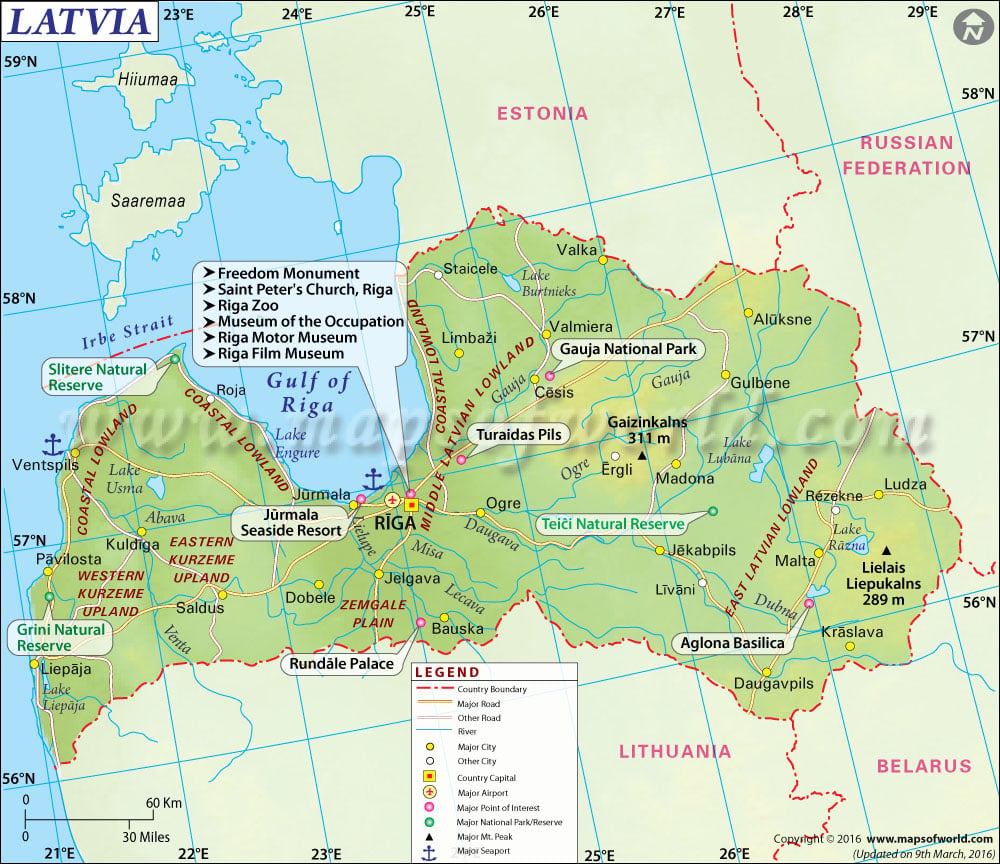
- Neighboring Countries - Estonia, Lithuania, Belarus, Russia
- Continent And Regions - Europe Map
- Other Latvia Maps - Where is Latvia, Latvia Blank Map, Latvia Road Map, Latvia Rail Map, Latvia River Map, Latvia Cities Map, Latvia Political Map, Latvia Physical Map, Latvia Flag
About Lativia
Explore this Lativia map to learn everything you want to know about this country. Learn about Lativia location on the world map, official symbol, flag, geography, climate, postal/area/zip codes, time zones, etc. Check out Lativia history, significant states, provinces/districts, & cities, most popular travel destinations and attractions, the capital city’s location, facts and trivia, and many more.
| Full name: | Republic of Latvia |
| Capital City: | Riga |
| Language: | Latvian (official), Russian (other) |
| Currency: | Lat (Ls) |
| Religion: | Lutheran, Roman Catholic, Russian Orthodox |
| National Anthem: | Dievs, sveti Latviju! (God, bless Latvia!) |
| Newspaper: | The Baltic Times, Baltische Rundschau, Business & the Baltics |
| Places to Visit: | Riga, Sigulda, Aglona Basilica, Latvian Occupation Museum, Museum of Horns & Antlers, Museum of Horns & Antlers |
| Transport: | Several international flights connect Riga with Berlin, Frankfurt, Geneva, Hamburg, Helsinki, Kiev, London, Moscow, Paris, Prague, Stockholm, Tallinn, Vienna, Vilnius, Warsaw and Zurich. Avail the bus route that link Riga with Denmark, Germany, Norway, Poland, Sweden, Russia, Belarus, Estonia and Lithuania. Take a ferry ride to Riga from Travemunde and Stockholm. |
| Shopping: | Riga, Sigulda, Aglona Basilica , Latvian Occupation Museum , Museum of Horns & Antlers |
Get a mystic touch of the Latvian countryside unscathed with architectural possessions of Gothic, Baroque and Classism buildings where one can catch up with coastlines swarming with pine trees, pre war towns that still carries the essence of the Soviet supremacy, the silent shores along the Baltic State, the picturesque castles and the mesmerizing river valleys.
Physical Map Of Latvia
Latvia is enclosed within dense forest covers, with about 12,000 miniature rivers and over 3,000 meandering lakes passing through the province. Latvia has low-lying fertile plains bordered by hilly terrains towards the eastern end, where Gaizinkalns stands as the country’s highest point stretching to about 1,020 ft high. Latvia is divided into two historic regions namely:
- The Western Dvina (Daugava) River (in north) comprising of Vidzeme and Latgale.
The southern region of Dvina, which consist of Kurzeme and Zemgale that once related to the duchy of Courland.
Along with the shallow waters of Gulf of Riga, the Baltic Sea bay even passes through the northwesterns part of the country. The state’s capital city being Riga is positioned on the shoreline of Baltic Sea bay, which is connected with the River Daugava. Daugavpils is one of the chief states, which is streamlined upriver, with Liepaja lying along the Baltic coast. Latvia is separated into five distinct regions, namely: Kurzeme (western part), Zemgale (central), Vidzeme (Middle land), Latgale, (northern) and Selija (eastern).
Location Of Latvia
Latvia is nestled in Northern Europe, sharing common borders with the two Baltic States.
It is engulfed by Estonia towards the northern region, Lithuania towards the southern end, while with Russia and Belarus towards the eastern end, while the western end is marked with Sweden.
Flag Of Latvia
Latvia’s flag was officially accepted in the month of February 27, 1990. The flag is designed with maroon colored or Latvian red colored two bands on the topmost and the bottom most of the flag and marked with a white band in the central position. The flag stands with a proportion of 2:1:2, where the color red symbolizes the injured Latvian leader who shed his blood for the country while the white denotes the cloth that was made use by covering over his wounds.
Climate Of Latvia
Get a maritime climatic condition while traveling to Latvia. Jaunt to Latvia during the month of May to September, stretching from spring to summer months, which is supposedly the best moment of the year to vacation. The daytime temperature in Latvia usually ascends to 16°C, while the months of July and August attracts several visitors during this period. January and February experiences the chilly wintry conditions with a temperature falling to about – 4°C especially during the daytime.
Flora And Fauna Of Latvia
There are about three basic national parks that preserve the country’s natural heritage of flora and fauna within the region. Several plants, lichen, mushroom, along with animal species and bird communities thrive along the region. The western region of the forested area of Latvia is famous for the presence of low shrubs filled with cross-leafed heath, while the eastern region is filled with broad leafy cinna, while the northern and southern region are known for the flying squirrel and the fat dormouse. Catch up with plants like the age-old pine trees, black alder mires, linden, oak and ash forests that are placed along the steep ravines within the state. Animals like the black storks or the Ciconia nigra; cliff eagles; lady’s slippers, lichens, mosses, seems to exist within the area. The black stork, the common black bird that has a white belly, a common version of the white stork was found within the region. Among the animals mention can be made of the wild boar, Eurasian beaver, and brown bear that are cozily placed in the region.
People Of Latvia
The religion surviving in the area of Latvia is covered mainly with the Christian population and the rest with the Lutheran, Roman Catholic and Eastern Orthodox inhabitants. Latvian is the official dialect of the region that fit in the Baltic group of language relating to the Indo-European family. Latvian was scripted in Latin while influenced by German. The local natives seem to be attached closely with the country, where one can find a blend between the Christian rituals with the primeval customs. Watch out for Russians, Belarusian, Ukrainian, Lithuanian, and Polish minorities residing within Latvia.
Arts, Culture And Music Of Latvia
Art: Watch out for pagan based geometric symbolic representation, which can be seen within the applied arts of the region. Glance through the paintings of the local artists at the National Fine Arts Museum settled along the Riga area, which is the cultural hub of the region.
Culture: Latvian literature emerged within the region that came along with the promotion of the culture through the famous laureate named Imants Ziedonis. The place consists of innumerable theaters placed near Riga, operas, symphony orchestras and circuses. Riga’s Dome Cathedral is a home to the largest musical organs in the world.
Music: The Latvian music is recognized through the folk song, which is referred to as the dainas, which is based on the pre-Christian idea and legendary folklore. The music is generally accompanied with humming vocal technique and Baltic zithers.
Economy Of Latvia
After the 1998 Russian financial crisis the region of Latvia emerged as a developed economy where the government initiated budget rigidity along with adjusting exported goods in response to the EU countries. The government privatized the local companies, banks, and real estate thereby holding stakes within large enterprises. Latvia soon became a part of the World Trade Organization in the month of February 1999. Government makes constant effort in growing the revenue competency thereby reducing the budget discrepancy within the country.
- The commodities that are exported from this region are wood, wood products, machinery, equipment, metals, textiles, and food items.
- The goods that are imported include machinery, equipment, fuels, chemicals and vehicles
- Industries that are settled here are agricultural machinery, synthetic fibers, fertilizers, radios, pharmaceuticals, processed foods, electronics, textiles, and timber.
