Gabon Map
 Buy Printed Map
 Buy Digital Map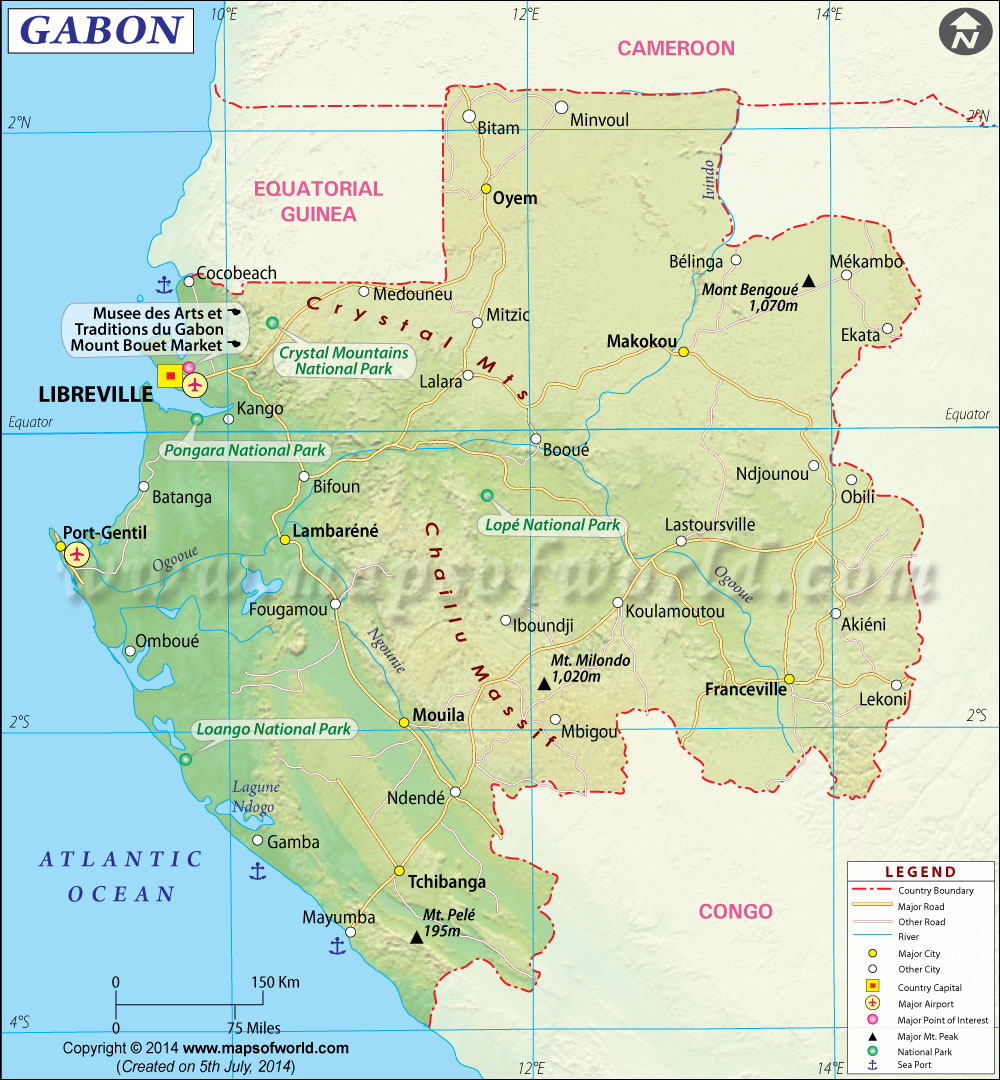
- Neighboring Countries - Equatorial Guinea, Cameroon, Republic of the Congo, Sao Tome Principe, Democratic Republic of the Congo
- Continent And Regions - Africa Map
- Other Gabon Maps - Where is Gabon, Gabon Blank Map, Gabon Road Map, Gabon Rail Map, Gabon River Map, Gabon Cities Map, Gabon Political Map, Gabon Flag
About Gabon
Explore this Gabon map to learn everything you want to know about this country. Learn about Gabon location on the world map, official symbol, flag, geography, climate, postal/area/zip codes, time zones, etc. Check out Gabon history, significant states, provinces/districts, & cities, most popular travel destinations and attractions, the capital city’s location, facts and trivia, and many more.
| Official Name | Republique Gabonaise, (Gabonese Republic) |
| Capital | Libreville |
| Population | 1.3 million (2001) |
| Area | 267,667 sq km or 103,346 sq mi |
| Currency | CFA Franc ($ 1 = 724.11) |
| Religion | Tribal Beliefs and Christianity |
| Literacy | 63% |
| Languages | French (official), Bantu dialects |
| Major Cities | Port-Gentil, Masuku |
| Climate | Hot and humid |
Formerly a province of French Equatorial Africa, Gabon won its independence on August 17,1960. Formerly a province of French Equatorial Africa, Gabon won its independence on August 17,1960.It is one of the most prosperous black African countries. A small population, abundant natural resources, and considerable foreign support have helped.
Physical Map of Gabon
A plateau extends over the entire northern and eastern parts of Gabon and some part of the south. A belt of coastal lowlands that is narrow lies in the western part. The Cristal Mountains lie in the north and are about 900 m (about 3,000 ft) high.
The central Chaillu Mountains contain Mount Iboundji (972 m/3,189 ft), the highest peak. Gabon has numerous rivers, notably the Ogoouè River that empties into the Atlantic. Most of the country is contained within the basin of the Ogoouè River, which is partly navigable.
Location of Gabon
Gabon lies in west central Africa. It is bounded on the northwest by Equatorial Guinea, on the north by Cameroon, on the east and south by the Republic of the Congo, and on the west by the Atlantic Ocean.
Gabon has a diverse ethnic makeup, although most of the inhabitants are Bantu-speaking. Of the country’s approximately 40 ethnic groups, most belong to the Fang, Mpongwe, M’Bete, and Punu groups. Europeans, mostly French, are a minority. Pygmies, believed to be the original inhabitants, are only a few thousand. About 90 percent of the population is Christian, primarily Roman Catholic, and about 5 percent is Muslim.
Flag of Gabon
Gabon’s flag contains three equal horizontal bands of green (top), yellow, and blue.
Climate of Gabon
Gabon has a hot and humid climate. Temperature variation is limited throughout the year. Daily temperatures average at 27°C (80°F). The periods from May to September and December to January constitute the dry seasons, while February to April and October to November constitute the rainy seasons.
Flora And Fauna of Gabon
About 85 percent of the land is covered by a dense equatorial rain forest. Gabon is rich in mineral resources. Therefore mineral production is the focus of revenue generation rather than the abundant forest cover. As a result, wildlife too is abundant. Protected areas cover 2.8 percent (1997) of the country, and hunting is prohibited. In spite of this, some species are under threat.
Economy of Gabon
Even though Gabon is rich in natural resources, poor fiscal management has hindered the economy though improvements are underway. The oil industry is the key to Gabon’s economy. Manganese mining is another key industry. Gabon also has a wealth of agricultural and fishery resources though largely neglected. Most of the population however relies on subsistence farming.
Arts, Culture and Music of Gabon
Masks have been very important in the tribal life of Gabon. Each mask represented the spirit linked to the life of the village and gave support and rules to individuals. Those that did not follow them were punished. The mask carved by an artist was approved of by the priest and introduced in a ceremony. At the end of their life, masks were destroyed according to specific rites which enabled them to pass their occult powers on to other masks. Masks were as varied and different as were tribes. Folklore is an important element in Gabonese culture. Its music has not been touched by outside influences, even though modern music has evolved separately. Gabon’s folklore seems close to the ancient art of the minstrel, where a storyteller, accompanying himself on the harp, recites half spoken, half sung epics. The shape and the playing of musical instruments has remained practically unchanged throughout the years. Drums, Tom-tom, balafon or xylophone are some common musical instruments.
