Nepal Map
 Buy Printed Map
 Buy Digital Map
 Wall Maps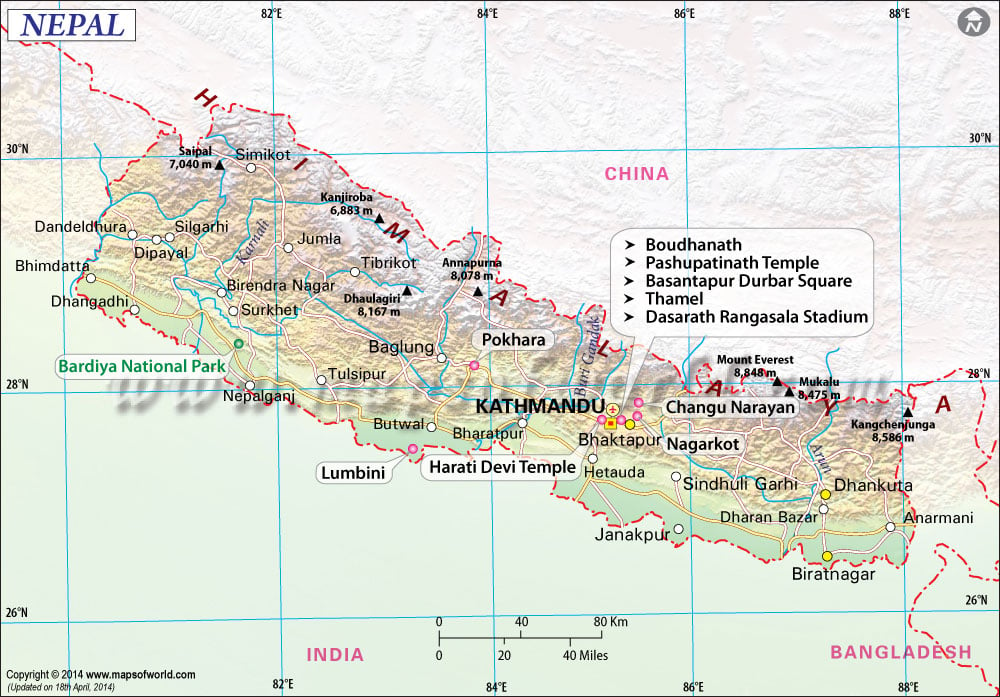
- Nepal Cities - Kathmandu
- Neighboring Countries - India, Bhutan, China, Bangladesh
- Continent And Regions - Asia Map
- Other Nepal Maps - Where is Nepal, Nepal Blank Map, Nepal Road Map, Nepal River Map, Nepal Political Map, Nepal Physical Map, Nepal Flag
About Nepal
Explore this Nepal map to learn everything you want to know about this country. Learn about Nepal location on the world map, official symbol, flag, geography, climate, postal/area/zip codes, time zones, etc. Check out Nepal history, significant states, provinces/districts, & cities, most popular travel destinations and attractions, the capital city’s location, facts and trivia, and many more.
| Official Name | Federal Democratic Republic of Nepal |
| Capital | Kathmandu |
| Population | 25,284,000 (2001) |
| Area | 147,181 sq km or 56,826 sq mi |
| Currency | Nepalese Rupee (US $1=75) |
| Religion | Hinduism, Buddhism, Islam |
| Literacy | 27% |
| Languages | Nepali (official), Maithir, Bhojpuri |
| Major Cities | Kathmandu, Pokhara, Biratnagar, Lalitpur, Birganj |
Republic of Nepal is a land where nature lovers revel in a unique Himalayan setting of great beauty, choosing from a variety of ways, suitable to their personal ideals of relaxation, meditation and pleasure.
Nepal is a land of rare scenic splendor unrivaled in the Himalayas. Bordering the Tibetan Plateau, her territory stretches 800 km east to west, and some of the highest peaks in the world, including Mt. Everest, mark her northernmost limits.
The land cascades sharply downwards in a short 200-km span through rugged mountains, coniferous, temperate and tropical forests, terraces of paddy, millet and corn to the low-lying foothills, which form the southern borders, where they join with the plains of India. It is a land of cultural diversity, being the religious crossroads of Hinduism and Buddhism, and is the birthplace of Lord Buddha and Goddess Sita.
Location of Nepal
Nepal is located in southern Asia and is couched between the two Asian giants of India and China. Ruled by a monarch until recently, Nepal is a strategically important country and is surrounded by the Indian mainland on the east, south and western sides respectively. It lies between the latitudes 26°N and 30°N and longitudes 80°E and 88°E.
Physical Map of Nepal
Nepal has four physiographic belts: the Terai plain along the Indian border, the sylvan Churia foothills and the Inner Terai zone to the north, the mid?mountain region, and the Great Himalayan Range. The Terai plain is low in elevation, flat, and fertile, being a northern extension of the Gangetic Plain and is some 26 to 32 km wide. In the south, it is agricultural, and where it joins the foothills, it is marshy and forested. The sparsely populated Churia Hills and the Inner Terai region rise to the rugged Mahabharata Mountain Range, which has elevations of 600-910 m; the intermountain basins are covered with forests. The mid-mountain region, between the Mahabharata Range and the Great Himalayas, has a complex system of ranges between 2,400 and 4,300 m that enclose the Kathmandu and the Pokhara valleys, two flat basins drained by the Baghmati and Seti rivers, respectively. The densely populated Kathmandu valley is the political and cultural hub of the nation. The Great Himalayan Range, from 4,300 to 8,800 m in elevation, contains several of the world’s highest peaks-Mt. Everest, Kanchenjunga I, Makalu I, Cho Oyo, Dhaulagiri I, Manaslu I, and Annapurna I-all above 8,040 m. The Kosi, Narayani (Gandak), and Karnali rivers run southward through transverse valleys of the Himalayan chain. They are Nepal’s major rivers and have large reserves of hydroelectric power.
Flag of Nepal
The flag of Nepal is red with a blue border around the unique shape of two overlapping right triangles. The smaller, upper triangle bears a white stylized moon and the larger, lower triangle bears a white 12-pointed sun.
Climate of Nepal
The climate of Nepal ranges from subtropical monsoon conditions in the Terai region to alpine Netherlands map conditions in the Great Himalayas. Annual rainfall ranges from 70 and 75 inches in the eastern Terai and between 30 and 35 inches in western Nepal. Flooding is a serious problem in the low-lying areas of the Terai plain during the monsoon season, from July to mid-October.
The winter season extends from November to March, when temperatures vary from 19°C in the southern Terai region to 13°C in the intermountain basins. During the summer season, which lasts through April and June, the mercury varies from 21°C to 28°C, in the same regions.
Flora And Fauna of Nepal
There are over 6,500 species of trees, shrubs and wildflowers in Nepal. The height of floral splendor is during the months of March and April when rhododendrons, the national flower, burst into color. Nepal’s principal natural resources are the forests, which cover about one-sixth of the country and provide valuable timber, firewood, and medicinal herbs. At the lowest elevations are tropical, humid, deciduous forests that harbor tigers, leopards, deer, monkeys, and a few Indian rhinoceroses. Above 1,200 m, the forests are evergreen and deciduous (oak, maple, magnolia), with occasional leopards and bears on the central Himalayan slopes. Between 3,050 and 3,650 m are coniferous forests with hare, deer, antelope, and small carnivores; above that are sub-alpine and alpine meadows of rhododendron and juniper, harboring musk deer and wild sheep. One can find around 800 different species of bird life in Nepal.
People of Nepal
The early settlement of Nepal was accomplished by large-scale emigrations of Mongoloid groups from Tibet and of Indo-Aryan peoples from northern India. Nepalese of Indo-Aryan ancestry constitutes the great majority of the total population. Tibeto-Nepalese peoples form a significant minority of the country’s population. Nepali, a derivative of Sanskrit, is the official language; Newari, a language of the Tibeto-Burman family, and numerous other languages are spoken. About 90% of the population is Hindu, and the remaining Buddhist.
The population is located mainly in rural areas. The urban population is primarily concentrated in Kathmandu. Nepalese people are divided into two distinct groups: the Indo-Aryans and the Mongoloids. Kathmandu Valley is the spiritual and cultural meeting point of all these groups. Nepal is the only Hindu Kingdom in the world. It is also the birthplace of Lord Buddha.
Arts, Culture and Music of Nepal
Music and dance are favorite pastimes in Nepal. Drums and wind instruments required in religious ceremonies have been preserved from ancient times. Devotional songs with folk and classical elements are an important feature of most religious and family occasions. Muttered chants, esoteric tantrik hymns and Nepalese music, whether it is the twang of a four-stringed saringhi or the plaintive notes of a flute, are very popular. Traditional folk musicians or gaines gather for an evening of singing and socializing, classical dancing and trance-like masked dances enliven the Kathmandu Valley and Bhaktapur regions, while no wedding would be complete without the raucous damais-Nepal’s modern ensembles.
Economy of Nepal
Nepal has an agrarian market economy. Agriculture accounts for about one-half of the GNP and employs more than nine-tenths of the workforce. Less than one-fifth of the total land area is arable, and agricultural productivity is very low. A hydroelectric station southeast of Kathmandu has proved to be very beneficial for the farmers.
Rice is the staple food. Maize, wheat, potatoes, sugarcane, and millets are also widely grown. Nepal is a major producer of medicinal herbs, which grow on the Himalayan slopes. Cattle, buffalo, goats, and sheep are raised. Forestry is an important industry.
The growing industrial sector accounts for much less than one-tenth of the GNP and employs less than 1 percent of
the total workforce. The government has promoted the use of domestic raw materials in manufacturing, and leading manufactures include cotton garments, bricks, tiles, paper, construction materials, and processed foods. Traditional products such as baskets, edible oils, and cotton cloth are produced by cottage industries.
