Jordan Map
 Buy Printed Map
 Buy Digital Map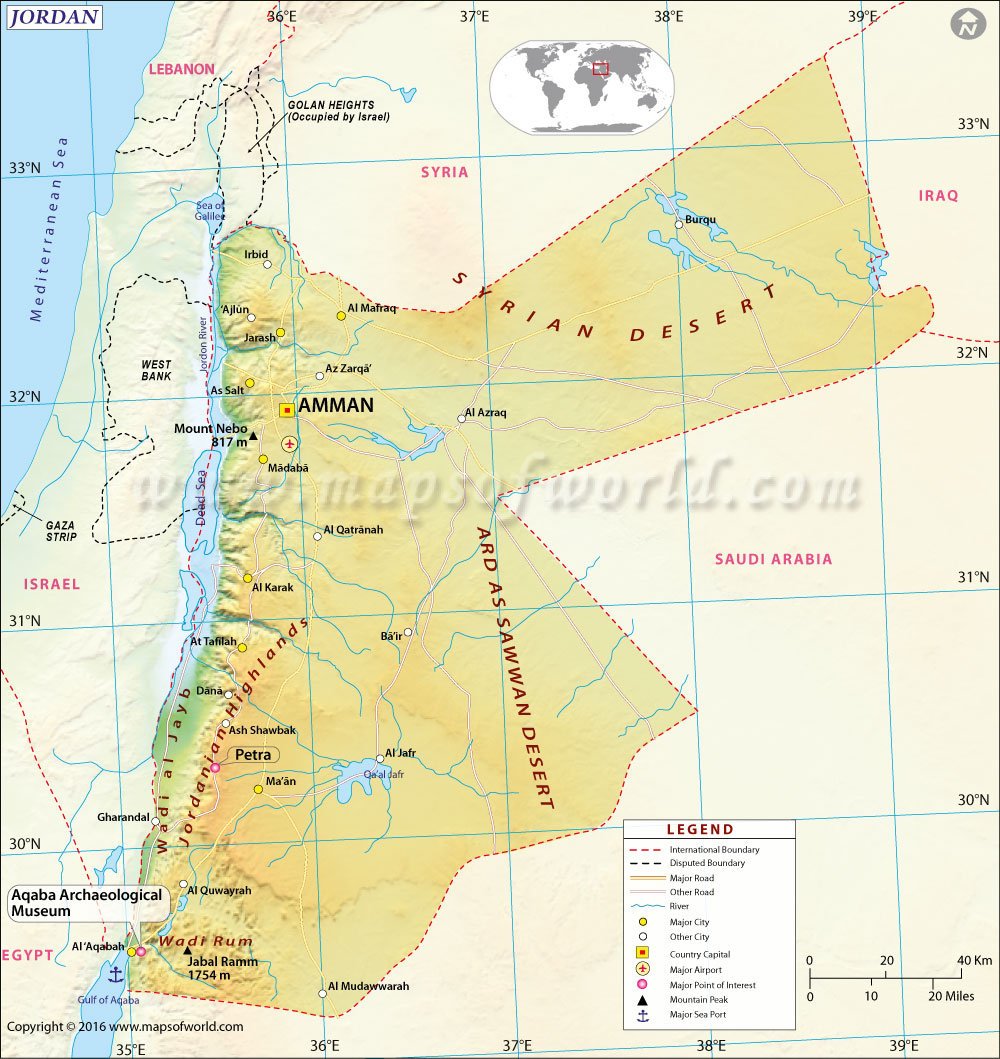
- Jordan Cities - Amman
- Neighboring Countries - Israel, Lebanon, Syria, Iraq, Saudi Arabia
- Continent And Regions - Asia Map
- Other Jordan Maps - Where is Jordan, Jordan Blank Map, Jordan Road Map, Jordan Rail Map, Jordan River Map, Jordan Political Map, Jordan Physical Map, Jordan Flag
About Jordan
Explore this Jordan map to learn everything you want to know about this country. Learn about Jordan location on the world map, official symbol, flag, geography, climate, postal/area/zip codes, time zones, etc. Check out Jordan history, significant states, provinces/districts, & cities, most popular travel destinations and attractions, the capital city’s location, facts and trivia, and many more.
| Official Name | Al-Mamlakah al-Urdunniyah al-Hashimiyah (Al-Urdun), (Hashemite Kingdom of Jordan) |
| Capital | Amman |
| Population | 5.1 million (2001) |
| Area | 89,287 sq km or 34,473 sq mi |
| Currency | Jordan Dinar($ 1 = 0.71) |
| Religion | Islam |
| Literacy | 87% |
| Languages | Arabic (official) |
| Major Cities | Zarka, Irbid, Salt |
| Climate | Mediterranean and arid desert |
Until the early 20th century, Jordan was part of Palestine, most of which is now the State of Israel. The area is home to one of the oldest civilizations in the world – archaeological finds from the west bank of the Jordan River have been dated at around 9000 BC.
Having had associations with three of the world’s greatest religions, Jordan has been a prized territory for Jews, Christians and Muslims.
Physical Map of Jordan
Jordan is an arid plateau that thrusts abruptly upward on the eastern shores of the Jordan River and the Dead Sea, reaching a height of about 610 to 915 m (about 2,000 to 3,000 ft), then sloping gently downward toward the Syrian Desert in the extreme east of the country. The Jordan Valley is in the deep depression of the Great Rift Valley. Deep canyons and mountainous outcroppings with elevations of approximately 1,500 m ( 4,900 ft) and more characterize the Arabian Plateau in the south of Jordan. The River Jordan, forming the country’s border with Israel and the West Bank, is the main drainage system.
Location of Jordan
Jordan lies in southwest Asia in the heart of the Middle East.
It is bounded on the north by Syria, on the east by Iraq and Saudi Arabia, on the south by Saudi Arabia and the Gulf of Aqaba, and on the west by Israel and the West Bank. Jordan has access to the Red Sea via the port city of Aqaba.
Flag of Jordan
Jordan flag contains three equal horizontal bands of black (top, the Abbassid Caliphate of Islam), white (the Ummayyad Caliphate of Islam), and green (the Fatimid Caliphate of Islam) with a red isosceles triangle (representing the Great Arab Revolt of 1916) based on the hoist side bearing a small white seven-pointed star symbolizing the seven verses of the opening Sura (Al-Fatiha) of the Holy Koran; the seven points on the star represent faith in One God, humanity, national spirit, humility, social justice, virtue, and aspirations.
Climate of Jordan
Mediterranean climates prevail in the north and west of Jordan, while the most of the country is desert. Generally, the country has warm, dry summers and mild, wet winters, with annual average temperatures ranging from 12 to 25 C (54 to 77 F) and summertime highs reaching the 40s (105-115 F) in the desert regions. Rainfall averages vary from 50mm (1.97 inches) annually in the desert to as much as 800 mm (31.5 inches) in the northern hills, some of which falls as snow.
Flora And Fauna of Jordan
Because much of Jordan is desert and steppe, plant life is not abundant. Grassland and wooded areas are found in the Jabal Ajlun district between Amman and the Syrian border. In these regions the trees include willow, oleander and tamarisk along the lower Jordan River valley and also ilex, olive, Aleppo pine, and palm. Wildlife includes the hyena, hyrax, gazelle, ibex, fox, partridge, mongoose, and mole rat; birds are also well represented.
People of Jordan
The population of Jordan is almost entirely Arab. TheCircassians and the Armenians form the racial minorities but are barely 1 percent of the population. Jordan is 79 percent urban; nomads and semi nomads represent about 5 percent. Sunni Muslims are a majority and Shia Muslims form a small minority. Christians, about one-third of whom belong to the Greek Orthodox Church, represent 4 percent of the population.
Economy of Jordan
Jordan is almost landlocked and has inadequate supplies of water, which makes it unsuitable for agriculture. Limited natural resources have hampered economic growth. Jordan heavily depends upon foreign aid from its oil rich neighbors. Recently, Jordan has embarked on economic reforms to improve the economy. The Jordanian government has worked closely with the IMF, practiced careful monetary policy, made significant progress with privatization and liberalized the trade regime sufficiently in order to guarantee Jordan’s membership in the Word Trade Organization.
Arts, Culture and Music of Jordan
There isn’t much sign of traditional Arabic music in Jordan, instead a hybrid of Arab-styles backed by western and traditional instruments are prevalent. The Bedouin still practice old musical traditions. The belly dancer is part of this tradition. Architecture is the predominant visual art in the Arab world, partly because Islam forbids the depiction of living things. Throughout Jordan spectacular mosques, ancient ruins and magnificent mosaics can be found. The Qusayr ‘Amra is notable for its frescoes, one of which shows a nude woman bathing – an unusual art form for this part of the world.
