Guatemala Map
 Buy Printed Map
 Buy Digital Map
 Wall Maps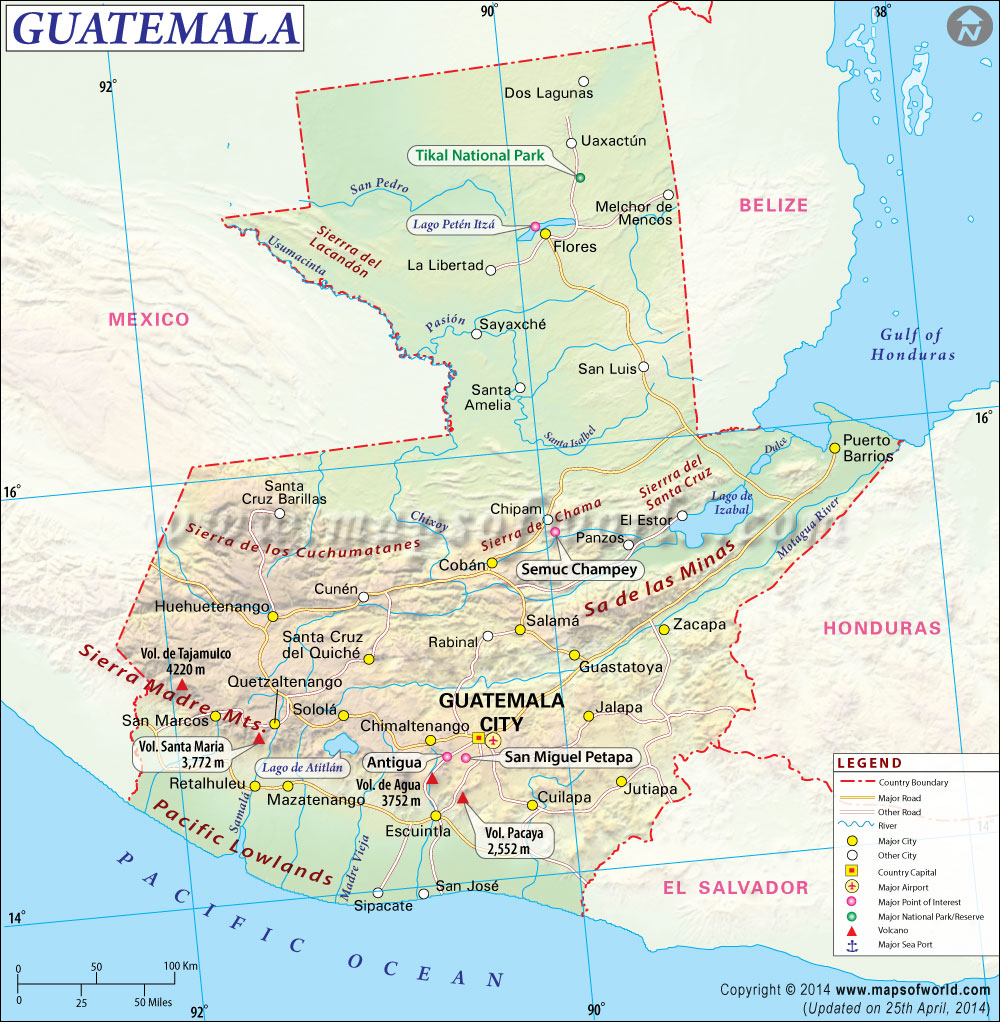
- Neighboring Countries - Belize, El Salvador, Honduras, Mexico
- Continent And Regions - North America Map, Americas Map
- Other Guatemala Maps - Where is Guatemala, Guatemala Blank Map, Guatemala Road Map, Guatemala Rail Map, Guatemala River Map, Guatemala Cities Map, Guatemala Political Map, Guatemala Physical Map, Guatemala Flag
About Guatemala
Explore this Guatemala map to learn everything you want to know about this country. Learn about Guatemala location on the world map, official symbol, flag, geography, climate, postal/area/zip codes, time zones, etc. Check out Guatemala history, significant states, provinces/districts, & cities, most popular travel destinations and attractions, the capital city’s location, facts and trivia, and many more.
| Official Name | Republica de Guatemala, (Republic of Guatemala) |
| Capital | Guatemala City |
| Population | 11.7 million (2001) |
| Area | 108,889 sq km or 42,042 sq mi |
| Currency | Quetzal ($ 1 = 7.92) |
| Religion | Christianity |
| Literacy | 56% |
| Languages | Language Spanish (official) and Indian Dialects |
| Major Cities | Mixco, Villa Nueva, Chinautla, Escuintla, Peurto Barrios |
| Climate | Good weather all year round |
Guatemala is known for its high and active volcanoes, for its impressive Mayan ruins and for its devastating earthquakes. A Spanish colony for almost 3 centuries, Guatemala became a republic in 1839, but has been plagued by civil wars since 1961. In 1996, the government signed a peace agreement formally ending the conflict.
Map of Guatemala
Guatemala’s geography has frequently influenced its history. About two-thirds of the country’s land area is mountainous. The rugged terrain has provided refuge to the indigenous people from Spanish conquest in the 16th century, while the fertile valleys produced fine coffees and other crops that dominated the nation’s economy. Frequent volcanic eruptions, earthquakes, and torrential rains have hampered the development of communication links.
Location of Guatemala
Guatemala lies below Mexico in Central America. It shares borders with El Salvador and Honduras to the east and with Mexico to the north and west. Belize borders it on the northeast. The Pacific
The Guatemalan lowlands bear plants typical of tropical areas. In the mountains oak trees dominate the lower slopes, giving way to pine forests above 2,100 m (7,000 ft). Orchids and other flowers grow abundantly throughout. Deer, monkeys, and pig like mammals called ‘peccaries’ are common in the sparsely populated lowlands. Other wild animals including jaguar, tapir, and puma-are found in smaller numbers, and crocodiles inhabit some rivers. Bird life is rich, but the brightly colored quetzal, Guatemala’s national bird, is rare.
Flag of Guatemala :
Guatemala’s flag contains three equal vertical bands of light blue (hoist side), white, and light blue with the coat of arms centered in the white band; the coat of arms includes a green and red quetzal (the national bird) and a scroll bearing the inscription LIBERTAD 15 DE SEPTIEMBRE DE 1821 (the original date of independence from Spain) all superimposed on a pair of crossed rifles and a pair of crossed swords and framed by a wreath.
Climate of Guatemala
It has a very good weather all year round, which is why it is often called “The Land of Eternal Spring”. Two seasons, namely, the dry season (from mid August thru April) and the wet season (from May to mid August) can be distinguished. The climate though, varies according to the elevation, from hot coastal plains to cold mountain slopes.
People of Guatemala :
Guatemala’s population, the largest in any Central American country, is almost evenly divided between Native Americans and ladinos, but also includes small groups descended from African and European immigrants. Within the population are widely varied ways of life, differing between ladinos and indigenous people, between urban and rural residents, between the more affluent and the very poor. The predominant religion is Roman Catholicism, into which many indigenous Guatemalans have incorporated traditional forms of worship. An estimated 40% and 1% of the population practices Protestantism and traditional Mayan religions, respectively.
Economy of Guatemala :
The Economy of Guatemala is agriculture based. Two-thirds of its exports are agricultural products and half of the labor force is involved in this sector. Coffee, sugar, and bananas are the main products.
Arts, Culture and Music of Guatemala : Guatemala’s culture is a unique product of Native American ways and a strong Spanish colonial heritage. About half of Guatemala’s population is mestizo (known in Guatemala as ladino), people of mixed European and indigenous ancestry. Ladino culture is dominant in urban areas and is heavily influenced by European and North American trends. But unlike many Latin American countries, Guatemala still has a large indigenous population, the Maya that has retained a distinct identity. Deeply rooted in the rural highlands of Guatemala, many indigenous people speak a Mayan language, follow traditional religious and village customs, and continue a rich tradition in textiles and other crafts. The two cultures have made Guatemala a complex society that is deeply divided between rich and poor. This division has produced much of the tension and violence that have marked Guatemala’s history.
