Burundi Map
 Buy Printed Map
 Buy Digital Map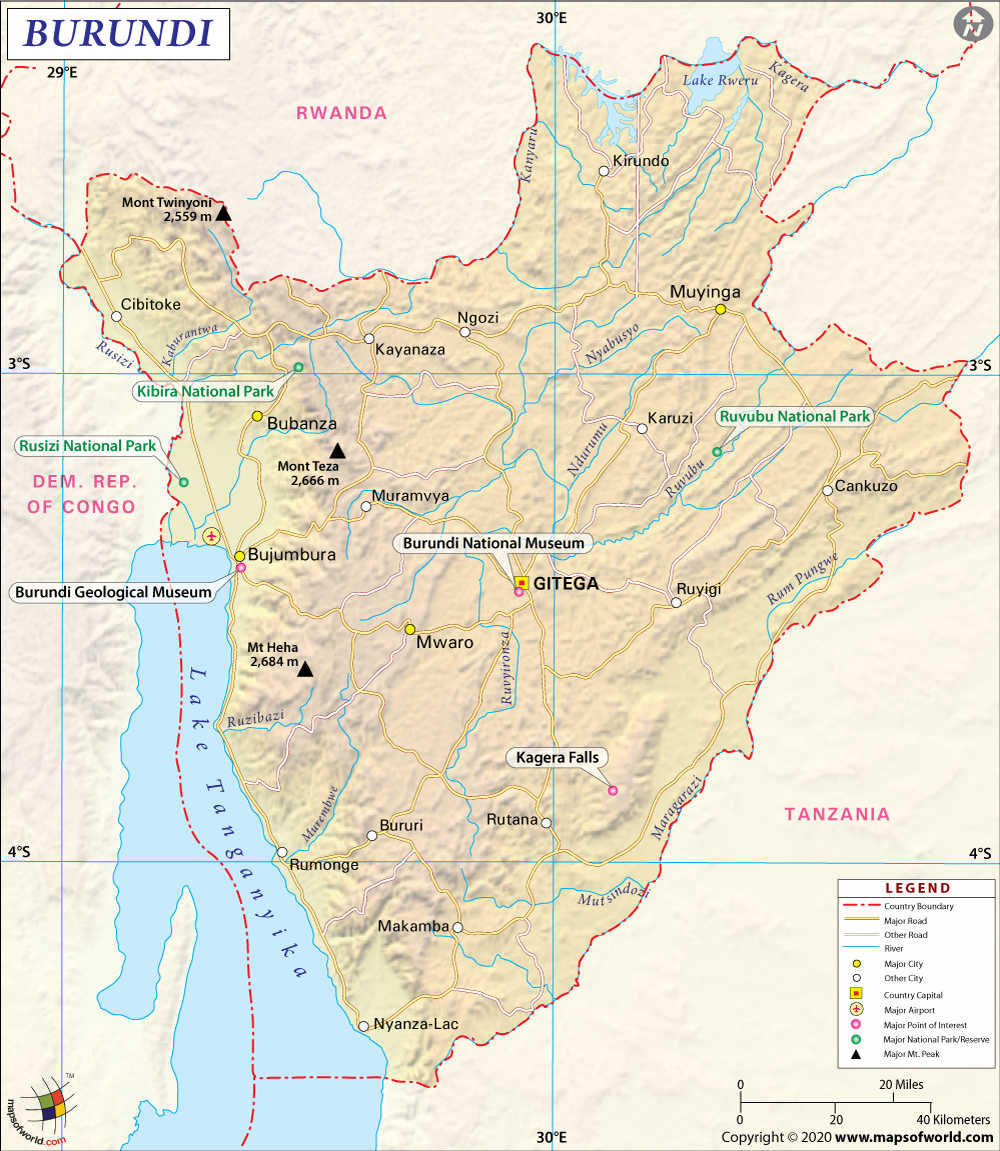
- Burundi Cities - Bujumbura
- Neighboring Countries - Democratic Republic of the Congo, Rwanda, Tanzania
- Continent And Regions - Africa Map
- Other Burundi Maps - Where is Burundi, Burundi Blank Map, Burundi Road Map, Burundi River Map, Burundi Political Map, Burundi Physical Map, Burundi Flag
About Burundi
Explore this Burundi map to learn everything you want to know about this country. Learn about Burundi location on the world map, official symbol, flag, geography, climate, postal/area/zip codes, time zones, etc. Check out Burundi history, significant states, provinces/districts, & cities, most popular travel destinations and attractions, the capital city’s location, facts and trivia, and many more.
| Official Name | (Republic of Burundi)-Republikay Uburundi |
| Capital | Bujumbura |
| Population | 6.5 million |
| Area | 27,834 sq km or 10,746 sq mi |
| Currency | Burundi Franc ($1=844.8) |
| Religion | Christianity & tribal customs |
| Literacy | 35% |
| Languages | French & Kirundi |
| Major Cities | Bujumbura, Kitega |
| Climate | Tropical in nature |
The Republic of Burundi is nestled in Great Lakes of Africa, which was previously known as Urundi-Ubrundi-Bruwanda. The present name came into existence from the language of Bantu, popularly known as Kirundi, which is the mothertongue of the region.
Burundi is even acknowledged as “The heart of Africa” which is nestled on the rolling plateau beside the Lake Tanganyika in its southwest region.
Physical Map of Burundi
The landscape of Burundi is filled with forested mountainous slopes that subside to the east to form a flat terrain of plateau, which is covered with savanna grassland, eucalyptus trees, banana groves and other major grasslands. Get undulating country view at Burundi, which is a part of Great African Plateau thereby dividing Nile and the Zaire River Basins into two separate regions.
The three major regions of Burundi are the Rift Valley, which is even referred to as Imbo. This narrow plain is quietly placed adjacent to the western border with Zaire. The eastern zone of Burundi is also known as Kumoso, which comprises of central and eastern plateau along with the savannas located on the eastern border. The central mountain zone lying towards north to south is filled with series of ridges.
Location Of Burundi
The capital city of Burundi is Bujumbura is the largest town having the highest peak named Mount Karonje, which carries the official currency of the Burundi Franc.
This mountainous range of Burundi run across from the north to the south and settles into Rwanda with Ruzizi River that outlines the western front of the region towards the north of Lake Tanganyika.
Burundi, a wonderful land locked country is nestled within east central Africa thereby bordering Rwanda towards the north, Tanzania to the east and south and the Democratic Republic of the Congo on the west.
FLAG OF BURUNDI
The flag of Burundi is well described in three different stripes of color divided by white diagonal cross, where the color red symbolizes the country’s independence struggle, the color green stands for hope and the white color stands for peace. The three stars that are placed in the center represents the nation’s motto that is Unity, Work and Progress with its three existing groups residing in Burundi that are Hutu, Tutsi and the Twa.
Climate Of Burundi
The climatic condition of Burundi varies from place to place as far as disparity in altitude and season is concerned. Defined as a tropical upland, this place experiences an equatorial climate thereby make is intolerably hot.
From June to August – Burundi observes dry season; from September to November- it observes short wet season; from December to January- the place observes short dry season and February- May- the place observes long wet season. Bujumbura experiences average rainfall while Kumoso upper elevated areas observes cool temperature.
Flora And Fauna Of Burundi
Burundi was once habitat to about 2,500 types of plants, 597 birds, 26 amphibians, 80 mammals, and 116 reptiles. These figures have subsequently reduced as this place was affected with habitat destruction where several animals were exposed to massive danger and threatening.
A nkole-Watusi cattle are supposedly the native animals of the region. Recognized for their giant horns, they were even known as “the cattle of kings.” Bred in the Nile Valley the Tutsi kings honored them for their milk. With little of wooded areas left the place is survived with plants like eucalyptus, acacia, fig, and oil palms.
Among the native animals one can view wildlife like elephant, hippopotamus, crocodile, wild boar, lion, antelope, and flying lemur and birds like guinea fowl, partridge, duck, geese, quail, and snipe. The crowned crane is supposedly the endangered species of the lot that is loosing its existence today. Fishes that thrive along the Lake Tanganyika include specimens like the Nile perch, freshwater sardines, and other rare breeds.
Do travel to the famous national parks of the region, which includes Kibira National Park in the northwest region, the Nyungwe Forest National Park in Rwanda and the Rurubu National Park to the northeast adjacent to the Rurubu River.
People Of Burundi
The multi-cultured folks of Burundi are divided into three main ethnic groups namely Hutu, Tutsi, and Twa. Though Kirundi and French is their official language, Swahili and Kiswahili are widely accepted in this region.
The Hutus, which are popularly dominant in the region, and Tutsis, that are economically established even indulge into intermarriage relationship with each other. The religious groups of Roman Catholicism, Protestants, Muslims mainly thrive in this region.
Arts, Culture And Music Of Burundi
Art: Burundians are known for their accomplished expertise in crafts and artwork. From making drums to masks, from basketry to beadwork, from shields to statuettes, from pottery to papyrus baskets, these people are trained well in their artistic skills. Bujumbura has been a favorite destination for exhibiting the creative proficiency, which is supposedly their native cultural hub. These people are also trained in metal craftwork that is sold to various customers that visit this place.
Culture: The place is rich in its culture where the local people resort to the native festivals, which is celebrated in full vigor. The sorghum festival known as umuganuro was once well celebrated where court dancers wore their traditional attire and performed with Karyenda the sacred drum. Drum is a vital instrument and is widely honored by the native people who resort to any kind of cultural celebration.
Music: The abatimbo is a local dance, which is performed at the local ceremony or in any official event of the place.
There are several kinds of dance in this area namely the Intore dancers, which are known for staging warlike concepts or the abanyagasimbo known for their acrobatic performances.
The musical instrument that the place is famous for are the ikembe – the thumb piano, the indonongo- fiddle, the umuduri- a bow-shaped musical device, the inanga- the sitar, the inyagara- rattle.
Economy Of Burundi
The economic development of Burundi relies on the agriculture industry where the country’s prime revenue is earned from the export of coffee. Burundi is rated for ranking as one among the world’s ten largest producers of cotton, tea, sorghum, maize, bananas and sweet potato, tapioca, beef and milk.
In terms of GDP per capita Burundi stands weaker in its prospects of growth. The foreign aids received from the Western Europe and other regions worldwide that sustain the economy of Burundi.
Other lighter industry like imported components, blankets, shoes, soap, public works construction and food processing play minor roles in its contribution to the economy.
