Austria Map
 Buy Printed Map
 Buy Digital Map
 Wall Maps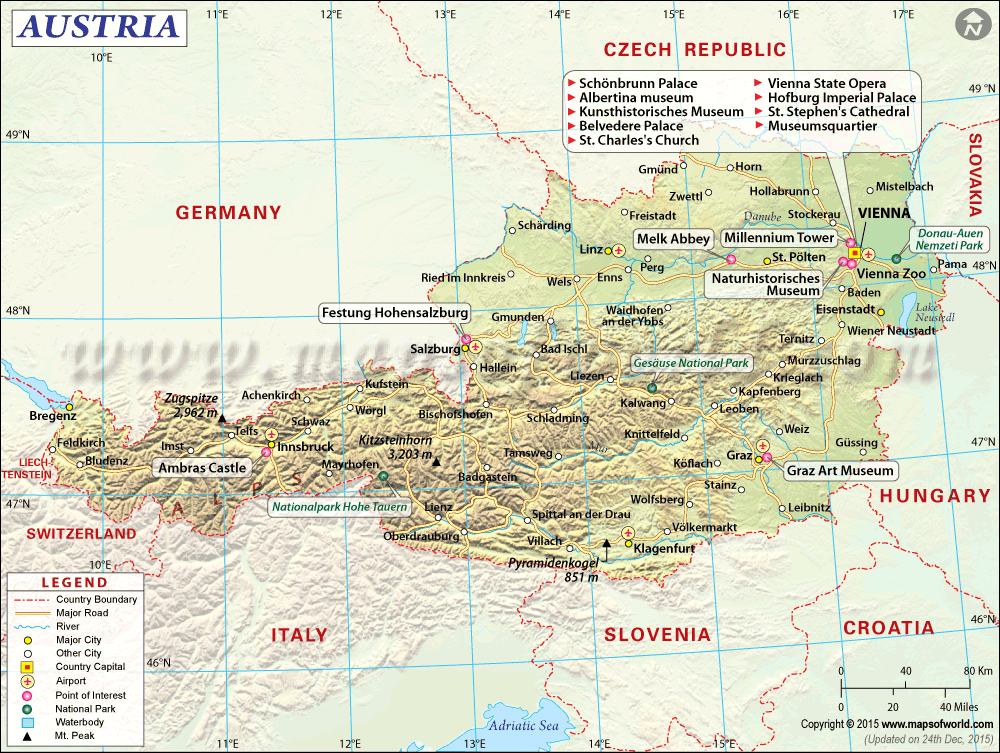
- Austria Cities - Alpbach, Arlberg, Bregenzerwald, Carinthia, Kaprun, Kitzbuhel, Klagenfurt, Lake Weissensee, Lech, Linz, Mayrhofen, Sankt Polten (St. Polten), Seefeld, Solden, St Wolfgang, Villach, Vorarlberg
- Austria States - Burgenland, Karnten, Niederosterriech, Oberosterreich, Salzburg, Steiermark, Tirol, Vorarlberg
- Neighboring Countries - Switzerland, Hungary, Slovakia, Italy, Slovenia
- Continent And Regions - Europe Map
- Other Austria Maps - Where is Austria, Austria Blank Map, Austria Road Map, Austria Rail Map, Austria River Map, Austria Political Map, Austria Physical Map, Austria Flag
History of Austria
Austria’s earliest inhabitants were Celtic tribes as far back as 800 BC, with the Kingdom of Noricum, later part of the Roman Empire. The Bavarians arrived in the region around the 6th century AD, forming the Duchy of Bavaria, around the same time that the Slavs and the Avars invaded. The region was conquered by Charlemagne in 788, bringing Christianity.
Austria (German: Österreich) was ruled by the House of Babenberg beginning in 976, around which time its name, meaning “eastern realm” referred to its location within the region. Austria became a duchy in 1192, and remained under the rule of the Babenbergs until 1246, when Ottokar II of Bohemia gained power. In 1278, the German Rudolph I took control until Austria became ruled by the Habsburg dynasty. The Habsburgs expanded their territory over the next centuries. In 1524, the Edict of Worms partitioned the dynasty, and Austria became ruled by Ferdinand I.
As the Ottoman Empire became a powerful force in the rest of Europe, the Austrian territory was threatened, but the Ottomans were kept out. Austria reached its greatest size in the 1700s, when it gained control of the Habsburg territories in the Netherlands and Italy, as well as in the Balkans.
In 1867, the Austrian Empire united with the Kingdom of Hungary in the Austro-Hungarian Compromise. When Archduke Franz Ferdinand was assassinated in 1914, World War I soon broke out, and the Austro-Hungarian Empire was dissolved in 1918. The Republic of Austria was formed in 1919-20. After a Nazi coup in 1934, Austria became a German state in 1936. By 1945, Austria was occupied by the British, Soviet, US and French, and reconstruction began in the following years.
Neighboring Countries :
Austria borders Germany, the Czech Republic, Hungary, Slovakia, Slovenia, Italy, Switzerland, and Liechtenstein.
Major Cities :
- Vienna (capital)
- Innsbruck
- Salzburg
Geography :
Austria is a landlocked country, located in the Alps of Central Europe. Though Austria has no coastlines, the Neusiedler See is located along the border between Austria and Hungary, while Lake Constance is situated along the border Austria shares with Switzerland and Germany.
The Alps cover almost two-thirds of Austria, and are the best known geographic feature of the country, while the Pannonian plain, the Bohemian Forests, and the Carpathian mountains make up the other geographic regions. Three ranges of the Alps are situated in Austria: the Northern Calcareous Alps, the Central Alps, and the Southern Calcareous Alps. The largest of these are the Central Alps, which are partially glaciated, and the country’s highest point is located at Grossglockner, which stands 3,797 meters (12,457 feet) above sea level. The major rivers in Austria are the Danube, the Elbe, and the Rhine.
Points of Interest :
With its location in the majestic Alps, Austria’s greatest attractions are its natural wonders. A popular skiing destination, the mountains of Austria feature ski resorts and great slopes. During the summer, the mountains are lush and green. A few of Austria’s best natural getaways include High Mountain National Park, National Park Thayatal, Villgratental, and Wachau.
In addition to its natural beauty, Austria offers historical sites and vibrant cities. In the capital, Vienna, are architectural sites including St. Stephen’s Cathedral and the Schloss Schoenbrunn, a castle and designated UNESCO World Heritage Site. Similarly, Innsbruck features the Schloss Ambras, and several churches in various styles, as well as museums and memorials from the nation’s history. Salzburg, best known for its portrayal in The Sound of Music, has many sites from the movie as well as castles and fortresses, an old town center and the Alter Markt Square, all set near the beautiful mountains and the Salzach River. More Travel Information…
Transportation :
Austria is centrally located with a strong transportation infrastructure, making it an important travel hub within Europe. Austria’s major international airport is located in the capital, Vienna. The other international airports are located in Innsbruck, Salzburg, Graz, Klagenfurt, and Linz, each offering limited international service and many domestic flights. Germany’s Munich airport is another option for entering Austria, as it is located just over the border from Austria. Trains and buses are quick and easy ways of getting into Austria from other European countries, as Austria is part of the Schengen agreement, and does not require border checks. While there are several international roads, which are well maintained, the terrain of Austria makes travel slightly more difficult to travel through the Alps. In cities, Austria has advanced public transportation options, including street trains (S-bahn), subways, or underground trains (U-bahn), as well as regional trains, buses, and taxis.