Angola Map
 Buy Printed Map
 Buy Digital Map
 Wall Maps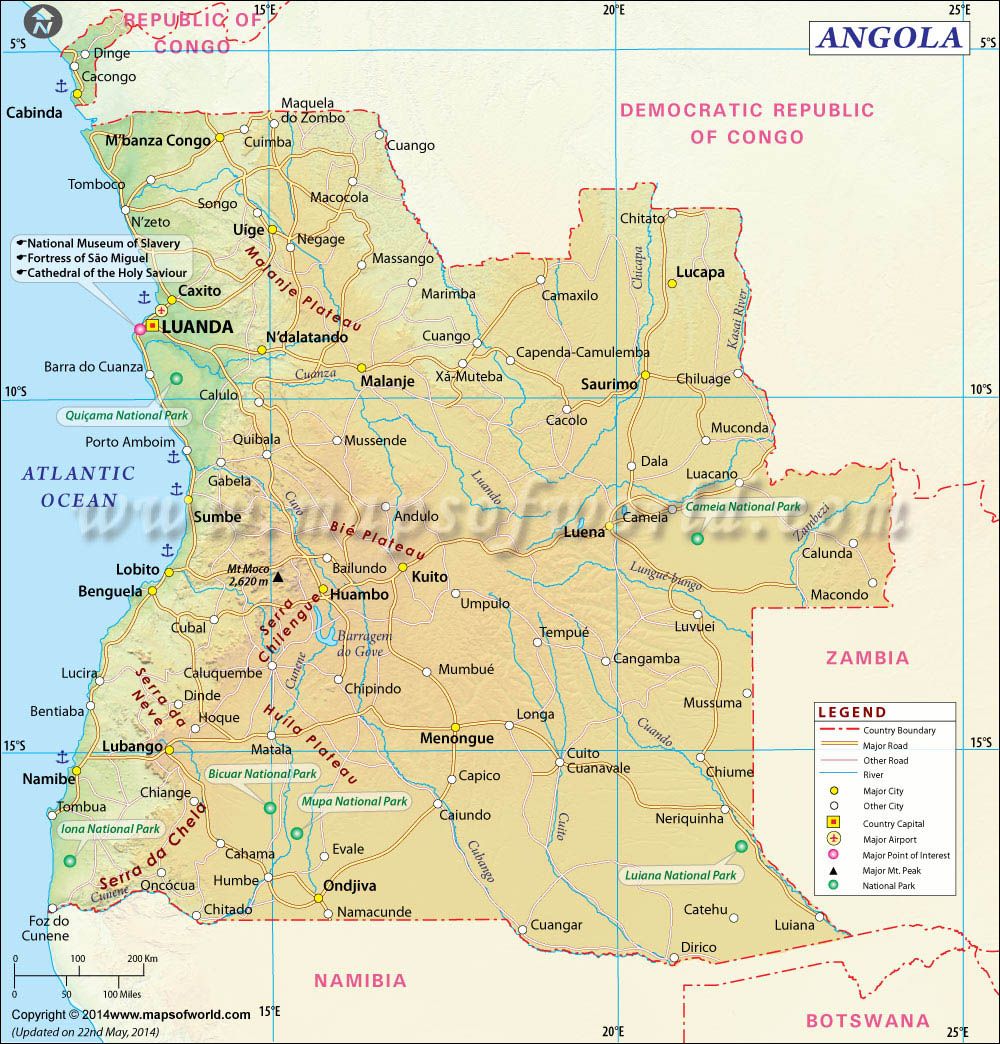
- Neighboring Countries - Namibia, Zambia, Democratic Republic of the Congo, Botswana, Republic of the Congo
- Continent And Regions - Africa Map
- Other Angola Maps - Where is Angola, Angola Blank Map, Angola Road Map, Angola Rail Map, Angola River Map, Angola Cities Map, Angola Political Map, Angola Physical Map, Angola Flag
About Angola
Explore this Angola map to learn everything you want to know about this country. Learn about Angola location on the world map, official symbol, flag, geography, climate, postal/area/zip codes, time zones, etc. Check out Angola history, significant states, provinces/districts, & cities, most popular travel destinations and attractions, the capital city’s location, facts and trivia, and many more.
| Name | Republic of Angola |
| Continent | Africa |
| Capital | Luanda |
| Independence | November 11, 1975 |
| Area | 481,354 sq mile |
| Population | 18,498,000 (2009 estimate) |
| Provinces | 18 |
| Major Languages | Portuguese, Bantu |
| Major Religions | Christianity, Indigenous Beliefs |
| Major Ethnic Groups | Ovimbundu,Ambundu,Bakongo and other African ,Mestico and Europeans |
| Form Of Government | Republic |
| Country Code | 244 |
| Currency | Kwanza (AOA) |
| GDP (PPP) | $115.679 billion (2011 estimate) |
| Time Zone | West Afria Time |
| Literacy | 67% |
Angola is a country located in the southwestern part of Africa. It was a Portuguese colony before it gained independence in 1975. It is bordered by Namibia to the south, Zambia to the east, the Democratic Republic of Congo and Republic of Congo to the north and east and the Atlantic Ocean to the west. While the southern part of the country has semi arid climate, the northern part experiences a cool and dry season from May to October and a hot and rainy season from November to April.
History
The history of Angola dates back to the time when the Koshian hunter gatherers inhabited the region which is known as Angola today. They were replaced by the Bantu tribe which came from the north and established several political units throughout the territory. The most famous of these is the kingdom of Kongo. Angola first came in contact with the Portuguese in the 15th century and by the end of the 16th century it became a Portuguese colony and continued to be so for the next 400 years. It was in the middle of the 20th century that demands for independence began to surface. This led to the guerilla war known as the Colonial war which was fought mainly by three factions viz MPLA, FNLA and UNITA. Finally, on November 11, 1975 Angola gained independence. But this did not result in peace as there was struggle for power between MPLA and UNITA. What followed was a 27 years long civil war which ended in 2002 after a ceasefire treaty was signed between the warring factions. The exclave of Cabinda has also seen some turbulent times with separatist forces demanding independence. The issue was finally resolved through an agreement signed in 2006. Peace has finally returned to Angola and the country is recuperating from the ravages of the civil war.
Economy
Angolan economy is one of the fastest growing economies of the world. The oil sector is the most important sector in Angola. It is the second largest producer of oil in sub Saharan Africa. Angola is also known for its diamond reserves. According to The Economist (2008) 60% of Angola’s income comes from this sector. Apart from these two various other minerals such as iron ore, phosphate, gold, and granite are found in Angola. The country is also rich in forest resources, fishery and has good prospects in hydropower sector. The agricultural sector was badly affected by the civil war. It is now largely dependent on food exports. But given its climate and arability of its soil, Angola has great potential in this sector.
Sports
The most popular sport in Angola is football (soccer). Angola has produced some players of great caliber who play for countries like France and Portugal. The National Football Team participated in FIFA 2006. Basketball is another popular sport and it is played by people belonging to all age groups. The Angolan team is ranked 13th in the world and has participated in both summer and winter Olympics.
Government
Angola is a unitary Republic with a Presidential form of government. The President is, however, not elected by the people. The President of the most powerful party in parliamentary elections will automatically become the President of the country. As the President enjoys tremendous power the principle of division of power is not practiced in Angola.
- The executive body of the government consists of the President, Vice President, and Council of Minister.
- The provinces are headed by Governors who are appointed by the President and whose tenure depends upon the pleasure of the President
Law and Order
Law and order situation seems fine during day, though petty theft, snatching, mugging are common at night particularly during festivals. Human rights violation is quite widespread. Human trafficking both internal and transnational is rampant. The victims of human trafficking further become victims of prostitution and forced labor. The government has taken several steps to prevent trafficking and protect the victims. The rate of prosecution is still low.
Culture and Society
Several African tribes like Ovibundu, Mbundu, Chowke with unique cultural traits inhabit Angola. They have managed to preserve the distinctiveness of the respective cultures and at the same time have made their contribution towards forming a composite Angolan culture. Portuguese influence is evident in various aspects of cultural life;be it language, religion, art, music , architecture or cuisine.
Art and Entertainment
The traditional art of Angola is closely associated with the cultural and religious rites to mark the important events of ones lives like birth, puberty, marriage, and death. The ceremonial masks made of ivory, wood, and ceramic crafted in the distinctive styles of different ethnic groups speak volumes about the ways of life of these people. Besides mask Angola also boasts of beautiful sculptures and other artifacts, the most famous of these being the statue of The Thinker of the Chokwe.
Music is an important part of Angolan life. Traditionally, story telling and music accompanied the use of the ceremonial masks. Contemporary music in Angola is inspired by Portuguese, Brazilian and Congolese music besides being influenced by the music of various ethnic groups. Rebita, a popular musical style originated in Angola.
People, Religion and Ethnic Groups
Angola is home to several ethnic tribes. The most prominent of them are Ovimbundu, Ambundu, Bakongo and Chokwe. There is also a small population of Mestico and Europeans. 47% of the people believe in indigenous religions, 38% are Roman Catholic and 15% are Protestants.
National Holidays and Festivals
The festivals of different ethnicities living in Angola are celebrated with equal ferver. Luanda Island Festival is one such famous festival that is held in honor of the water god Kianda in November. Christianity is a major religion and festivals associated with it such as the Carnival, Christmas, and Easter are celebrated with great enthusiasm. There are also several important secular events celebrated across the country. The Sumbe Music Festival is held every year in September in Sumbe that is attended by many international musicians.
The commemoration of the Martyrs of Colonial Repression Day (4th January) which marks the beginning of the struggle for Independence is an important day. Angolans also zealously celebrate their Independence Day (11th November) which is also a national holiday. Other important national holidays are Liberation Movement day (4th February), Peace Day (4th April), International Women’s Day (8th March),International Labor Day(1st May), National Heroes Day(17th September) and Memorial Day(2nd November) to name a few.
