Andorra Map
 Buy Printed Map
 Buy Digital Map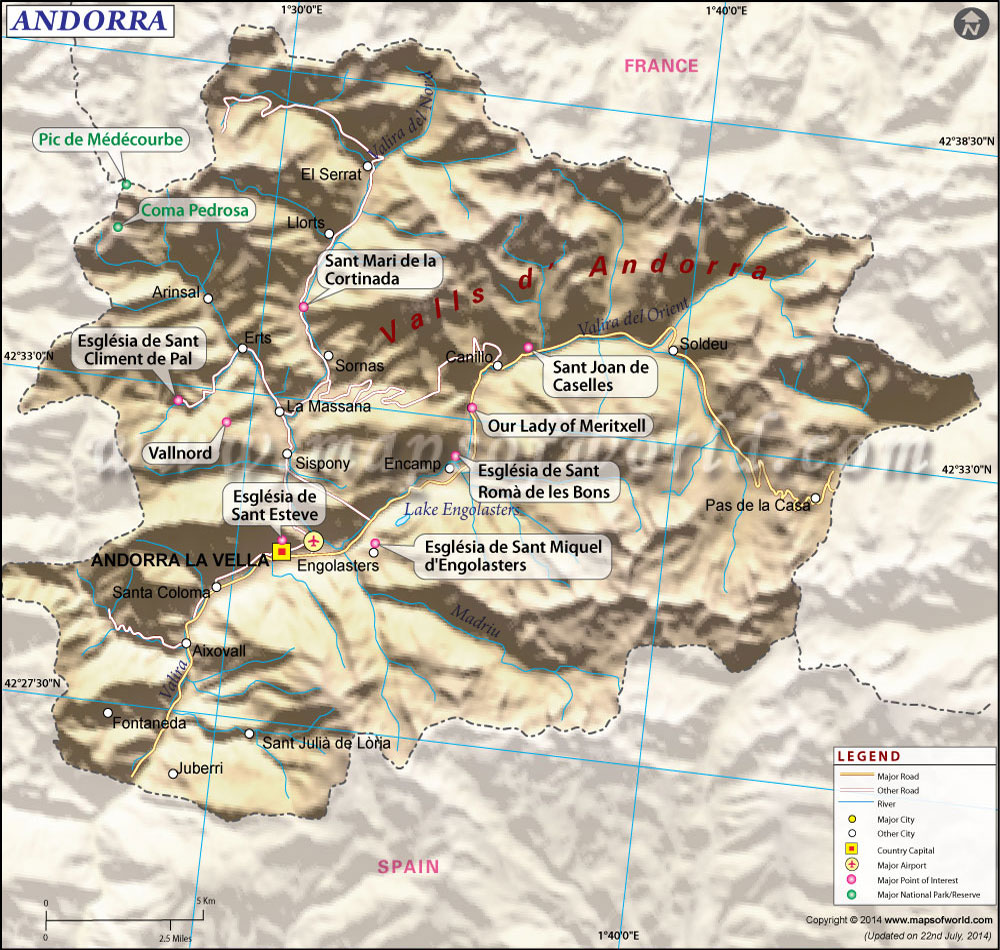
- Neighboring Countries - France, Spain
- Continent And Regions - Europe Map
- Other Andorra Maps - Where is Andorra, Andorra Blank Map, Andorra Road Map, Andorra River Map, Andorra Cities Map, Andorra Political Map, Andorra Physical Map, Andorra Flag
About Andorra
Explore this Andorra map to learn everything you want to know about this country. Learn about Andorra location on the world map, official symbol, flag, geography, climate, postal/area/zip codes, time zones, etc. Check out Andorra history, significant states, provinces/districts, & cities, most popular travel destinations and attractions, the capital city’s location, facts and trivia, and many more.
| Official Name | Principality of Andorra |
| Capital | Andorra La Vella |
| Population | 85,082(2011 est.) |
| Area | 180 square miles |
| Currency | Euro (EUR) |
| Country Code | 376 |
| Time Zone | Central European Time |
| Literacy | 100% |
| Languages | Catalan, Spanish, French, Portuguese |
| Major Cities | Andorra La Vella, Canillo, Encamp, Els-Plans, Ordino, La-Massana, Sant Julia de Loria, Escaldes. |
| Climate | Mountain Climate, snowy, cold and temperate |
| Major Religions | Roman Catholic |
Sixth smallest nation of Europe, Andorra has a total area of 180 square miles. Situated on the border of France and Spain in south west Europe, this country is also the highest inhabited in the continent. Its geographic coordinates are 42⁰ 30’ N, 1⁰ 30’ E. Andorrans enjoy mountain climate with mild temperature in summer and low in winter. Winters are very cold and snowy. Its temperature varies with altitude with an average of 10⁰ C – 11⁰C in the south to about 2⁰ C in the north. There are about sixty small natural lakes in the country, which are also major tourists’ attraction apart from the magnificent mountains.
History
The history of Andorra dates back about thousand years. It is believed that Emperor Charlemagne granted a charter to the people of Andorra in gratitude for their fight against the Muslim Moors. In 988 AD, the Count of Urgell, gave Andorra to the Bishop of Diocese of Urgell in exchange of a territory. In the 11th century, the bishop sought protection from a Spanish Nobleman ‘Lord of Caboet’, fearing the Count of Urgell will take Andorra back. Both bishop and Lord signed a declaration of their co-sovereignty over the country. Later a French nobleman Count of Foix through marriage became heir to the Lord of Caboet and claimed authority over Andorra, this dispute was resolved by 1278 with signing of a Pareage, which declared country’s sovereignty be shared between the Count of Foix and Bishop of Urgell.
Following the agreement Andorrans were ruled till 1993 by co-princes from France and Spain. In 1993, the government changed into parliamentary democracy, with honorary position of the ‘head of the state’, remaining with the co-princes of France and Spain. This change in the government set up was mainly due to the recommendation from Council of Europe in 1990, which proposed if Andorra wanted to attain full incorporation in the European Union; it should adopt a modern constitution by giving freedom to the Andorrans to elect their own leader.
Economy
Tourism is the main industry supporting Andorra’s economy; it has about 80% contribution in the country’s GDP. Retail sales, banking, and finance are other important sectors, which contributes substantially to the country’s economy. Andorra has also been popular for its tax haven status; however, now the status is affected by the opening of the borders of Spain and France resulting in availability of variety of goods at lower tariffs.
Andorra’s agricultural contribution is very low, mainly because of its mountainous terrain; it is mere 2 % of the GDP, and thus many food products are imported. The major agricultural products are cereals, vegetables, and rye. The country also produces tobacco products of high quality, most of which is exported to France and Spain. Andorra has limited natural resources mainly hydroelectric power, timber, mineral water, lead, and iron ore.
Andorra is one of the countries with lowest unemployment rate; in fact it achieved 0% of unemployment in 2007. Andorra enjoys a special relation with European Union, it is allowed to have price differences from the other EU countries, and thus visitors enjoy duty free benefits.
Sports
Andorrans are sports enthusiasts; they enjoy watching and playing a number of sports. Andorra is recognized for its winter sports. Skiing, mountain biking, cycling, soccer, and rugby are popular sports. Skiing is not only a dominant sport in Andorra; it is also one of the key contributing factors to the country’s economy. Millions of tourist visits this mountainous country for its skiing facilities. Andorra government ensures that the infrastructure for the sporting activities is well maintained. Apart from skiing, Andorrans are also passionate about soccer. ‘Derby’ the soccer match, between Catalan Barcelona and Franco’s team ‘Real Madrid’, which is held bi-annually is the most watched by the Andorrans. Andorra’s local league is also increasingly gaining strength. The country is represented by the ‘Andorra National Football’ team, in the soccer matches. Roller Hockey is also another popular sport in Andorra. Andorra plays in FIRS Roller Hockey World Cup as well as in CERH Euro Cup.
Government:
Andorra’s political set up has unique characteristic of co-principality, with leaders from France and Spain as co-princes. From 1278 till 1993, Andorra’s sovereignty has been shared between France and Spain. In 1993, with recommendation from the Council of Europe, Andorra’s constitution granted universal adult franchise to the people of the country.
Since 1993, Andorra has parliamentary democracy with multi-party system. The dominant political parties are Andorra for Change (ApC), Democrats of Andorra (DA), and Liberal Party and Reformist Coalition. The government has three branches namely the Executive, the Legislative, and the Judiciary.
The executive council includes the head of the government and seven ministers. The government exercises executive powers. The legislative body comprises of 28 members and the legislative power is exercised by both the parliament and the government. Judiciary is an independent body and the ‘Superior Court of Justice’ is the highest court with five members. Princes of France and Spain are the co-regents of the state but have limited powers.
Law and Order
Crime is low in Andorra. Conviction rates for larceny are highest in the country. From 1995-2000, the rate of larceny has increased from 1201.59 per 100,000 population to 1253.03 per 100,000 population (an increase of 4.3%). Other crimes such as burglary, robbery, fraud, drug trafficking, and murder, occur rarely and the rates are low due to a high level of law and order. Law and order is maintained by the Andorra Police Force, which is also the national police force. Andorra has a small army, with ceremonial duty for the army men.
Culture and Society
Catalan is the essence of Andorran culture. Andorra de Vella, the capital city is also the cultural center of the country, which organizes jazz festivals, art exhibitions, folk dances, and musical concerts. Andorra’s folk dances are very popular. The national dances such as the marratxa, the contrapas, the ball de santa anna and sardana, attract tourists to this country; locals enjoy these dances during festivals.
From a traditional rural society Andorra has transformed into a modern country in the 20th century, mainly because of the incoming of the tourists. The native Andorrans are mainly located in the capital city and in its neighboring areas. The Andorrans are family oriented people. The Andorran society till the late 20th century was male dominated, with the male members of the family involved in all the public activity, the scenario is changing now with the women actively involving themselves in public affairs.
Arts and Entertainment
Andorra’s architecture boasts of simple yet magnificent Romanesque churches. The famous artist Nikolai Siadristyi of Ukraine also has his museum of miniatures in Andorra. There are many art galleries in all the major cities of the country. The Claret brothers of Andorra have gained admiration throughout Europe for their music. Andorra has two public and ten commercial radio stations and one public TV station.
People, Religion, and Ethnic Groups
With a population of 85,000, Andorra is one of the smallest nations of the world. The native Andorrans comprise only about 35%, rest are nationals from Spain, France, Portugal, Britain and other countries. Andorra does not have an official religion, though about 90% of the Andorrans follow Roman Catholicism, and ‘Our Lady of Meritxell’ is their patron saint. The population has many ethnic groups, which enjoy cordial interethnic relations. The major ethnic groups are Andorran, Spanish, French, and Portuguese.
National Holidays and Festivals
As Roman Catholicism is the dominant religion, most of the catholic holidays are religious holidays of the country. Christmas and New Year is celebrated with much enthusiasm. Andorrans decorate their homes with flowers and set off fireworks at many places on these days. The other national holidays are Epiphany, celebrated on January 6. Most business remain closed on other national holidays like Constitution Day on March 14, Easter on April 8, Labor Day on May 1, St. John Day on June 24, this day also marks the start of the summer solstice. Our Lady of Meritxell Day on September 8 is the national day of Andorra.
