Bosnia Map
 Buy Printed Map
 Buy Digital Map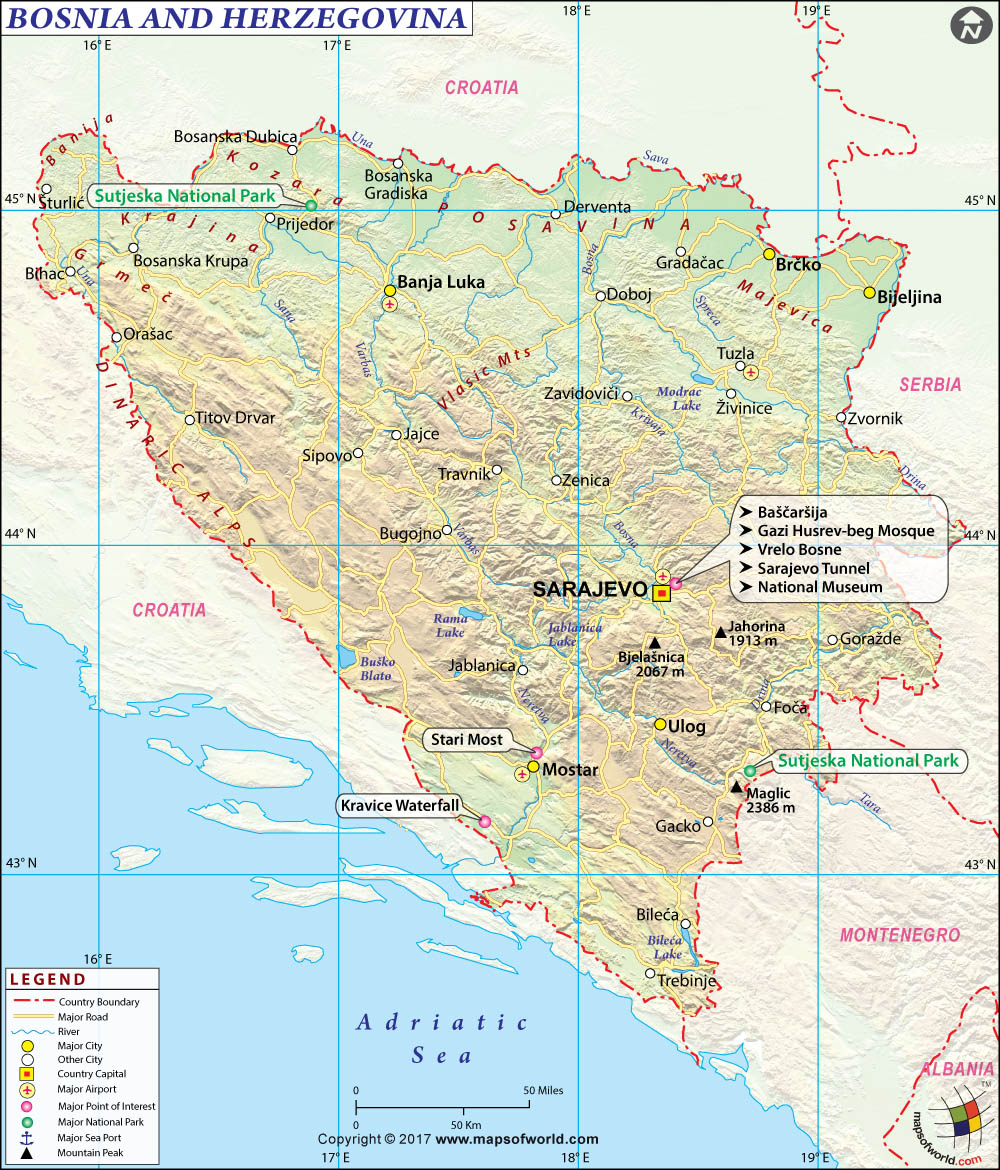
- Neighboring Countries - Montenegro, Serbia, Croatia, Italy
- Continent And Regions - Europe Map
- Other Bosnia Maps - Where is Bosnia, Bosnia Blank Map, Bosnia Road Map, Bosnia Rail Map, Bosnia Cities Map, Bosnia Political Map, Bosnia Physical Map, Bosnia Flag
About Bosnia
Explore this Bosnia map to learn everything you want to know about this country. Learn about Italy’s location on the world map, official symbol, flag, geography, climate, postal/area/zip codes, time zones, etc. Check out Bosnia history, significant states, provinces/districts, & cities, most popular travel destinations and attractions, the capital city’s location, facts and trivia, and many more.
| Official Name | (Republic of Bosnia and Herzegovina) Republika Bosnia Hercegovina |
| Capital | Sarajevo |
| Population | 4.1 million |
| Area | 51,129 sq km or 19,741 sq mi |
| Currency | Conv. Mark |
| Religion | Christianity and Islam |
| Literacy | 86% |
| Languages | Serbo-Croatian |
| Major Cities | Sarajevo, Banja, Luka, Tuzla, Mostar |
| Climate | Mediterranean in the south and Continental in the north |
Bosnia and Herzegovina, also known as Bosnia, was initially a Republic of former Yugoslavia.The country passed a referendum for independence on 3 March 1992, when a Serb republic was formed in Serb-concentrated areas of Bosnia.
The Serb opposition to the referendum was soon followed by violent clashes where thousands lost their lives. These conflicts finally came to an end only in February 1996, the year which also saw the capital Sarajevo being united after remaining divided for four years.
Physical Map of Bosnia & Herzegovina
Bosnia is a mountainous country, where the extensions of the Dinaric Alps, bordering Bosnia in the west, pass through the western and southern parts of the country. The highest peak is Mount Maglic, measuring 7,831 ft, along the border with Serbia and Montenegro. The northern part of Bosnia is made up of mainly forests, while the southern part has fertile soil. The country’s principal rivers include the Bosna, the Sava, which flows along the northern frontier, and the Sava’s tributaries, the Una, Drina, and Vrbas. Only a few rivers, notably the Neretva, flow toward the Adriatic Sea, where Bosnia has 20 km of coastline.
Location of Bosnia & Herzegovina
The country of Bosnia and Herzegovina is still divided geographically into a northern region of Bosnia and a southern region of Herzegovina.
The country is bound on the north and west by Croatia and on the east and south by the republic of Serbia and Montenegro.
Flag of Bosnia & Herzegovina
The flag of Bosnia consists of a wide medium blue vertical band on the fly side with a yellow isosceles triangle abutting the band and the top of the flag; the remainder of the flag is medium blue with seven full five-pointed white stars and two half stars top and bottom along the hypotenuse of the triangle.
Climate of Bosnia & Herzegovina
While the south of Bosnia has a Mediterranean climate, with sunny, warm summers and mild, rainy winters, the north experiences continental climate made up of warm summers and cold winters. At higher elevations, short, cool summers and long, severe winters with snow are common.
Flora And Fauna of Bosnia & Herzegovina
Bosnia, with a rich stock of natural resources, has large tracts of fertile land and deep forests. The main natural vegetation consists mainly of Beech forests. The fauna of Bosnia includes hares, lynxes, weasels, otters, foxes, wildcats, wolves, gray bears, chamois, deer, eagles, vultures, mouflon (wild sheep), and hawks. Some endangered species like Lynxes, weasels, and otters are also found here.
People of Bosnia & Herzegovina
Bosnia has no majority in a single ethnic group, in fact, the 1991 census showed that the country is made up of 44 percent of Muslims, 31 percent of Serbs, 17 percent of Croats, 6 percent of Yugoslavs (people of mixed Muslim, Serb, and Croat ancestry), and 2 percent of others.
Bosnia also has a small number of Roma (Gypsies) as well as a small section of Jews. Until independence, most of the people were urbanized, following a well-standard life style while the lesser well-off stayed in rural areas. But the war and the subsequent crash of economy have resulted in a drop in the standard of living and have seen many former working-women being confined to homes as mothers and housewives.
Arts, Culture and Music of Bosnia & Herzegovina
The country has a rich and wonderful cultural heritage, where epic stories recited in the form of songs is famous through out Bosnia. The country is also famous for its love songs which have been used to express love over the centuries.
Economy of Bosnia & Herzegovina
As Bosnia has rich natural resources, the economy is mainly governed by mining, forestry, agriculture, and some sectors of light and heavy manufacturing, notably of armaments. But the country had to pay a high price for war in terms of a shattering economy whose recovery is slowly picking up only now. Though the country exported specialty agricultural products, such as fruit and tobacco, it had to import staples, including more than half its food.
